
How to Reconstitute Research Peptides | Dosage & Bac Water Guide | Quantum Labs
Step-by-step reconstitution guide for research peptides — bacteriostatic water, dose-volume math, storage, and common reconstitution mistakes to avoid.
Why reconstitution matters in peptide research
Research peptides are supplied as lyophilised powder — freeze-dried, sealed, and stable for shipping at room temperature for short periods. Before use, the powder needs to be reconstituted with a diluent into a working solution. For Australian researchers receiving research-grade material for the first time, the reconstitution and dose-calculation process is where a lot of practical questions cluster: how much diluent to add, what diluent to use, how to calculate dose volumes, how to handle the resulting solution, how long it stays viable.
This article walks through the standard reconstitution process used across research-grade peptide work, plus dose-volume math, storage guidance, and a few practical gotchas worth knowing before the first vial gets opened. The framing is research-grade laboratory work — for therapeutic questions, a qualified medical practitioner is the right referee.
What you need to reconstitute a peptide
A standard reconstitution setup involves four things:
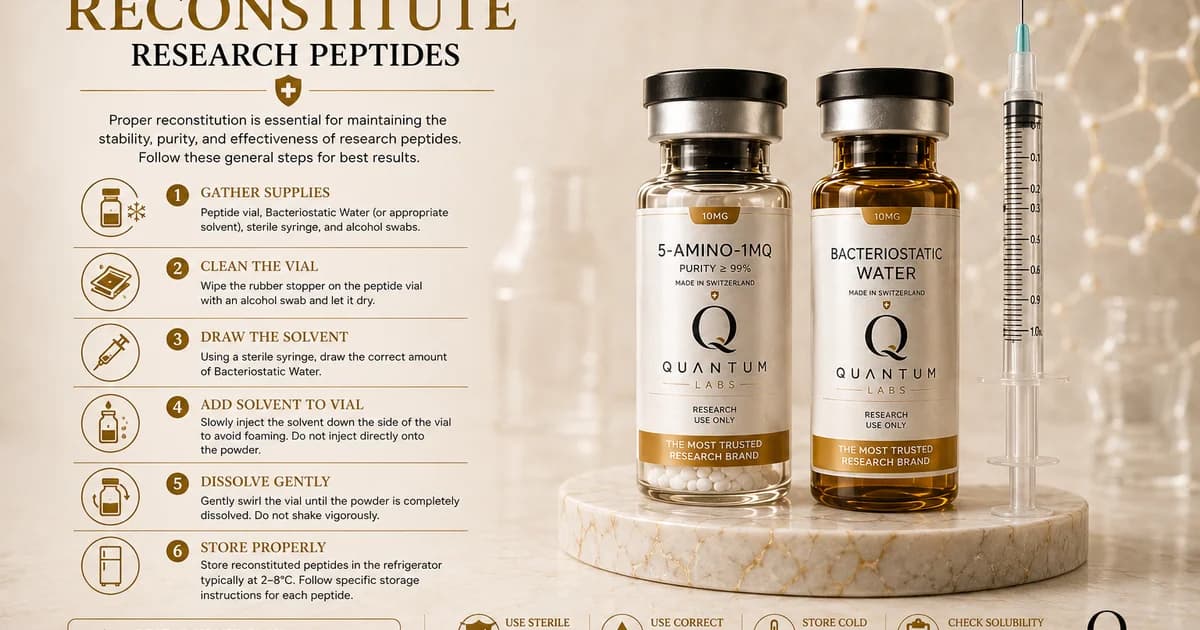
- The lyophilised peptide vial. Sealed, with a rubber stopper covered by a flip-cap. Don't remove the stopper — pierce it with a needle to deliver the diluent.
- Bacteriostatic water. Sterile water containing 0.9% benzyl alcohol as a bacteriostatic preservative. Standard diluent for multi-use research peptide vials. Quantum Labs supplies bacteriostatic water as a separate research supply.
- An insulin-style syringe. Typically 0.5 mL or 1 mL with very fine needle (29-31 gauge). The same syringe is used to draw diluent and to draw working solution for dosing.
- Alcohol swabs. For wiping vial stoppers before piercing — keeps the multi-use vial sterile across withdrawals.
Why bacteriostatic water specifically
The diluent matters. Two main options for research peptide reconstitution:
Bacteriostatic water (BAC water)
Sterile water with 0.9% benzyl alcohol as a preservative. The benzyl alcohol is bacteriostatic — it prevents bacterial growth in the reconstituted solution, allowing multi-use of the vial over weeks. This is the standard choice for research peptides that will be used over multiple sessions.
Sterile water (no preservative)
Pure sterile water without preservative. Produces a single-use solution — bacterial contamination is rapid once the vial is breached. Used for single-use applications or for peptides that are sensitive to benzyl alcohol (rare).
For most research applications, bacteriostatic water is the correct choice. The 30-day stability window after reconstitution that researchers expect from research peptides is largely a function of the preservative — not an inherent property of the peptide itself.
Step-by-step reconstitution
The process is straightforward but easy to get wrong on the first attempt. The standard sequence:
1. Determine the diluent volume
The volume of bacteriostatic water you add determines the working concentration of the reconstituted solution. There is no single “correct” volume — researchers choose a volume that produces a working concentration that makes their dose-volume math straightforward.
A common choice for a 5 mg vial is 2 mL of bacteriostatic water. That produces a working concentration of 2.5 mg/mL (or 2,500 μg/mL), which makes typical research-protocol dose volumes land in the easy-to-measure range on an insulin syringe. Other common ratios are 1 mL (giving 5 mg/mL) for smaller dose volumes, or 3 mL (giving ~1.67 mg/mL) for larger volumes.
2. Wipe the stoppers with alcohol swabs
Flip up the plastic caps on both the bacteriostatic water vial and the peptide vial. Wipe each rubber stopper with an alcohol swab and let dry. This is the standard sterile-handling step for any multi-use vial work.
3. Draw the diluent
Use a fresh syringe. Draw a volume of air equal to your intended diluent volume into the syringe. Insert the needle into the bacteriostatic water vial, inject the air (which equalises pressure in the vial), then invert the vial and draw the diluent into the syringe.
4. Inject the diluent into the peptide vial
Insert the needle into the peptide vial. Critically: do not inject the bacteriostatic water directly at the lyophilised powder — angle the needle so the water runs down the inside wall of the vial. Direct high-pressure injection at the powder can disrupt the peptide structure.
5. Allow the powder to dissolve
The lyophilised powder will start dissolving as soon as the diluent contacts it. Do not shake the vial. Mechanical agitation can damage peptide structure. Instead, swirl gently or simply let the vial sit. Most peptides dissolve within a few minutes; some may need 10-15 minutes. If powder remains, swirl gently again.
6. Inspect the solution
A properly reconstituted peptide solution should be clear and colourless (or very faintly tinted depending on the specific compound). Cloudiness or persistent particles can indicate a problem — sub-spec material, freezing damage in transit, or a peptide that shouldn't have been reconstituted with bacteriostatic water. If anything looks wrong, don't use the vial.
Dose-volume math: how to calculate
Once reconstituted, calculating a dose volume comes down to two numbers: the working concentration (set by the diluent volume you chose) and the target dose for the research protocol.
The formula:
Dose volume (mL) = target dose (μg or mg) ÷ working concentration (μg/mL or mg/mL)
A worked example. Suppose you have a 5 mg BPC-157 vial reconstituted with 2 mL of bacteriostatic water — that's a working concentration of 2,500 μg/mL. The research protocol targets a 250 μg dose. The calculation:
250 μg ÷ 2,500 μg/mL = 0.1 mL
On a standard insulin syringe marked in units (100 units = 1 mL), 0.1 mL is 10 units. The math is consistent: the working concentration sets the units-per-microgram ratio regardless of which specific dose volume the protocol calls for.
For protocols using a different reconstitution volume, recompute the working concentration first. A 5 mg vial in 1 mL of bacteriostatic water is 5 mg/mL = 5,000 μg/mL, so the same 250 μg dose becomes 0.05 mL (5 units). Always re-derive the concentration when changing diluent volumes.
Storage after reconstitution
Once reconstituted with bacteriostatic water, the working solution should be:
- Stored at 2-8°C. Standard fridge temperature. Don't freeze reconstituted solutions — the freeze-thaw cycle damages peptide structure.
- Used within ~30 days. The bacteriostatic preservative is effective for around a month under refrigeration; beyond that, both bacterial growth and peptide degradation become real concerns.
- Kept upright and away from light. Light exposure isn't a fast destroyer, but minimising exposure preserves peptide integrity over the storage window.
- Re-wiped with alcohol on the rubber stopper before each withdrawal — maintains the sterile multi-use property of the bacteriostatic preservative.
Lyophilised powder (unopened, before reconstitution) is much more stable than reconstituted solution: typically several months refrigerated, or several weeks at room temperature. The general principle is to keep peptides lyophilised as long as possible and reconstitute only what will be used within the 30-day window.
Common mistakes to avoid
A few practical gotchas worth knowing:
- Shaking the vial. Mechanical agitation damages peptide structure. Swirl gently, never shake.
- Freezing reconstituted solution. Damages structure on thaw. Keep refrigerated, never frozen.
- Using sterile water for multi-use vials. Bacterial contamination is rapid without preservative. Bacteriostatic water with 0.9% benzyl alcohol is the correct multi-use diluent.
- Withdrawing too quickly. Air bubbles in the syringe interfere with dose-volume accuracy. Withdraw slowly and tap the syringe to release bubbles before measuring.
- Reusing needles. Always use a fresh needle for each withdrawal. A reused needle re-introduces contamination into the vial and reduces sterile lifespan.
- Direct-injection at the powder. Disrupts peptide structure. Let the diluent run down the vial wall rather than impacting the powder directly.
Compound-specific considerations
Most research peptides reconstitute identically. A few have quirks worth knowing:
- GHK-Cu reconstituted solutions are a faint blue colour due to the copper coordination — this is normal, not contamination. See the GHK-Cu product page.
- Semax and Selank are typically delivered intranasally rather than injected — reconstituted solution is loaded into a nasal spray bottle rather than drawn into a syringe. The reconstitution process itself is identical; only the delivery format differs.
- NAD+ reconstitutes into a slightly tinted solution depending on concentration. Higher working concentrations can take longer to fully dissolve — extra patience and gentle swirling.
- BPC-157 + TB-500 combo vials in our Recovery & Repair Stack are reconstituted the same way as single-compound vials — the two peptides co-exist stably in solution within the standard 30-day window.
Where reconstitution sits in the wider research framework
The reconstitution process is a research-laboratory step. It is not therapeutic preparation. Quantum Labs supplies research-grade compounds — the reconstitution guide above is designed to support legitimate pre-clinical research work, not to substitute for a pharmacist's role in preparing a therapeutic medicine for human use.
For questions about human therapeutic use, dosing for personal application, or specific clinical contexts, the right referee is a qualified medical practitioner. The research-supply framework discussed in our peptide legality guide sits separately from the prescription medicine pathway, and the two shouldn't be conflated.
Sourcing both the peptide and the bac water. Quantum Labs supplies HPLC-verified research peptides and bacteriostatic water from Australian stock, batch-traceable to certificates of analysis. Bacteriostatic Water → · Browse all compounds →