
Peptide Cycling 101 for Research Protocols | Quantum Labs
Why research peptide protocols run in 6-12 week cycles, how washout windows work, why stacks combine compounds, and how PCT applies to GH-axis research.
Why research peptides are studied in cycles
Walk into a search for “peptide cycle length” or “peptide stack” and you'll see a wide variation in answers. The reason is that peptide cycling isn't a single discipline — it's a family of related practices, each tied to the specific research literature the cycle is designed around. A tissue-repair research cycle has different requirements to a hormone-axis research cycle, which has different requirements again to a nootropic-pathway research cycle.
This article walks through why research peptide protocols are structured in discrete cycles, what factors determine cycle length, how washout windows are designed, and how research stacks combine multiple compounds. The goal is the general-purpose framework that informs the specific protocols we supply at Quantum Labs.
Three reasons research uses cycles
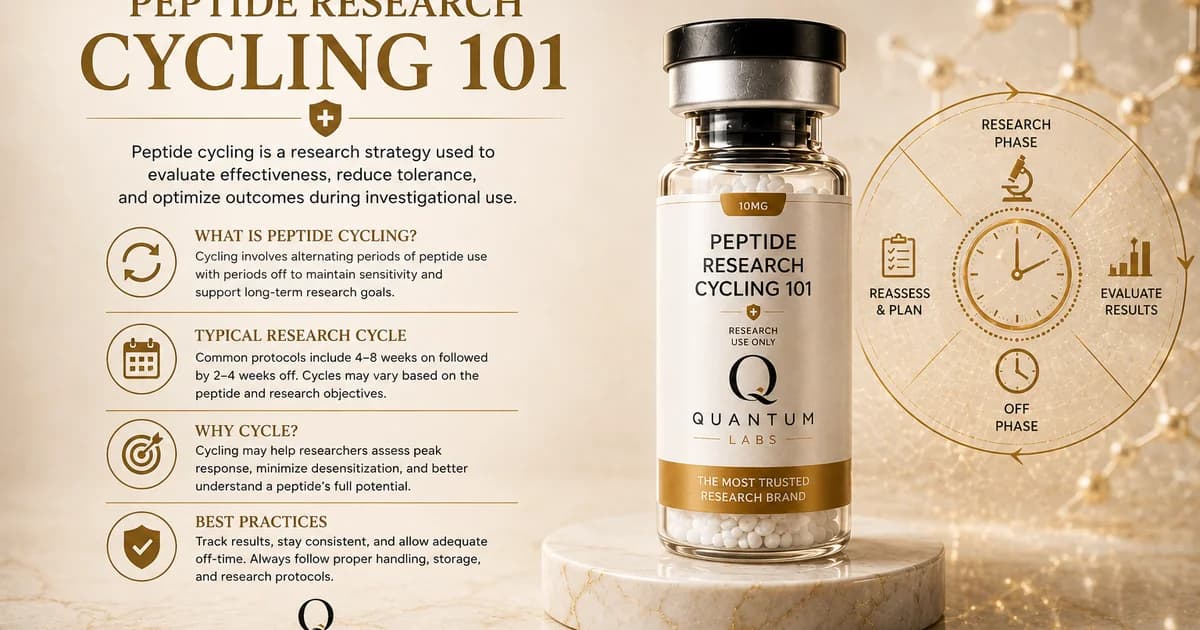
Peptide research protocols don't run indefinitely. They're structured as discrete cycles for three reasons that recur across the published literature regardless of compound family:
1. Receptor density downregulation
Most research peptides act on G-protein-coupled receptors (GPCRs) or related receptor families. Prolonged ligand exposure tends to reduce receptor density on the cell surface — receptors are internalised through endocytic pathways and either degraded or recycled at a lower steady-state level. The functional consequence is reduced response to the same dose over time, a phenomenon researchers refer to as desensitisation or downregulation.
Cycling provides a defined window for ligand exposure followed by a washout period during which receptor density can recover. The biological logic is direct: if you want to measure response again with the same dose, the receptors need to be there to bind.
2. Clean statistical comparison
Research designs typically need to compare cycle-on measurements with cycle-off measurements. Without a clear washout, the carryover effect from the previous cycle contaminates the off-cycle baseline. Published protocols almost always include a washout period of at least half the active cycle length precisely for this reason — it's a statistical requirement, not just a biological one.
3. Regulatory and ethical framework
Most published research protocols operate within institutional and regulatory frameworks that specify maximum continuous-exposure windows. The 8-12 week ranges that recur in published research aren't arbitrary — they reflect common ethics-committee guidelines for pre-clinical research studies.
Common cycle lengths in research literature
Cycle length isn't one-size-fits-all. The most common ranges in published research literature, by research area:
Recovery and tissue-repair research
- Acute soft-tissue injury models: 4-6 weeks.
- Chronic-load or rehabilitation models: 8-12 weeks.
The Quantum Labs Recovery & Repair Stack is structured around the 8-week middle-ground commonly used in tendon and connective-tissue repair research.
Fat-loss and metabolic research
- Acute incretin-pathway research: 4-8 weeks.
- Body composition and metabolic-flexibility research: 8-16 weeks.
The Fat Loss Protocol uses an 8-week structure aligned with the most common incretin-pathway research cycles.
Hormone-axis research
- Growth-hormone axis research: 8-16 weeks (10-12 most common).
- Ageing-axis research in older populations: 12+ weeks.
The Hormonal Support Protocol runs 12 weeks — the longer adaptation window appropriate for ageing-axis research questions.
Nootropic and CNS research
- Cognitive-performance research: 4-8 weeks (effects are measurable earlier than tissue-repair endpoints).
The Cognitive & Energy Stack is structured around the 6-week window typical of Semax / Selank research.
Washout windows: how long, and why
The washout window is the off-cycle period during which the research subject is no longer exposed to the compound under study. Two main factors drive washout length:
Compound half-life
The washout needs to last at least 4-5 half-lives of the compound for plasma concentrations to fall to negligible levels. For short-half-life compounds (like Ipamorelin or short-acting GHRH analogues), washout can be as brief as 1-2 weeks. For long-half-life compounds (like CJC-1295 with DAC), washout extends to several weeks.
Receptor recovery
Even after plasma levels fall to zero, downregulated receptor density needs time to recover. Published research has shown receptor resensitisation timeframes that vary substantially by receptor type. A general rule of thumb is washout = 50% of active-cycle length, but this should be adjusted based on the specific compound and receptor system under study.
Why protocols stack multiple compounds
A single-compound research design is the cleanest way to isolate a specific mechanism, but real research questions often involve multiple pathways. Tissue repair, for example, involves vascular response, inflammatory modulation, cell migration, proliferation, and collagen synthesis — no single compound is studied across all of these with equal weight, so stacked-compound research is common in the tissue-repair literature.
The cardinal rule of research peptide stacks is complementarity, not redundancy. The compounds in a stack should target different parts of the cascade. Stacking two compounds that act on the same receptor is rarely informative — you get receptor saturation rather than additive coverage.
Examples of complementary stacking in research
- BPC-157 + TB-500: BPC-157 covers nitric oxide and angiogenic signalling; TB-500 covers actin and cell migration. The two pathways are non-overlapping.
- CJC-1295 + Ipamorelin: CJC-1295 binds the GHRH receptor; Ipamorelin binds the ghrelin receptor. Both drive growth-hormone release but through independent pathways.
- Semax + Selank: Both are Russian-developed nootropic peptides delivered intranasally, but Semax targets monoaminergic pathways and Selank targets GABAergic anxiolytic pathways.
- Retatrutide + MOTS-c + L-Carnitine: Three different fat-oxidation pathways — central appetite regulation, cellular AMPK signalling, and mitochondrial fatty-acid transport — combined into a single research stack.
Dose timing within a cycle
How a dose is timed within the 24-hour day matters. Published research has converged on several conventions:
- GH secretagogues (CJC-1295, Ipamorelin, Tesamorelin) are typically administered pre-sleep to align with the natural overnight GH pulse, or in pre-training windows for performance-research designs.
- Tissue-repair peptides (BPC-157, TB-500) are typically administered consistently at a fixed time of day; the half-lives don't require strict alignment with biological rhythms.
- Nootropic peptides (Semax, Selank) are typically administered in the morning when the research endpoint is cognitive performance during the waking day.
- Incretin-pathway compounds are typically studied via once-weekly subcutaneous dosing aligned with the compound's extended half-life.
Phase structure within a cycle
Most published research cycles are organised into three phases, even when the cycle is short:
Phase 1 — Ramp and baseline (15-25% of cycle)
Establish baseline measurements for the research endpoints before introducing the compound. For compounds requiring dose titration, this is when the titration happens. The phase should be long enough to confirm baseline stability.
Phase 2 — Peak intervention window (50-70% of cycle)
The compound is at full research-protocol dose. This is the window in which the bulk of the research endpoints are measured. Stability is the goal — consistent dosing, consistent handling, consistent measurement.
Phase 3 — Taper and post-intervention (15-25% of cycle)
For compounds requiring tapered withdrawal, this is when the dose is reduced. For compounds that can be stopped abruptly, this phase is the post-intervention measurement window — measuring how endpoints respond once the compound is removed. This is essential for measuring persistence of effect, one of the most informative endpoints in cycle-based research.
PCT and the post-cycle question
Post-cycle therapy (PCT) is a concept borrowed from androgen-receptor-agonist literature, where it refers to structured interventions designed to restore hypothalamic- pituitary-gonadal (HPG) axis function after a suppressive compound is withdrawn. The PCT framework applies to research protocols that target the HPG axis — not to most peptide research.
The protocols Quantum Labs supplies — tissue repair, fat loss, performance, cognitive, hormonal — primarily target the tissue-repair pathways, the GH-IGF-1 axis, central nervous system pathways, and metabolic regulation. None of these suppress the HPG axis the way androgen-receptor agonists do, so structured PCT is not part of the standard protocol design. Researchers should monitor the specific biomarkers relevant to their compound and study question, but traditional PCT (clomiphene, hCG, etc.) isn't the right framework for these research areas.
Tracking research outcomes
Every cycle should have pre-specified endpoints — measurements that will be taken at baseline, mid-cycle, and post-cycle. The endpoints depend on the research question:
- Tissue repair: functional measurements, inflammation biomarkers, imaging where available.
- Fat loss: body composition (DEXA where possible), metabolic biomarkers, weight trajectory.
- Hormone axis: IGF-1, GH measurements, relevant hormonal biomarkers.
- Cognitive: standardised cognitive performance batteries, sleep quality measurements.
Pre-specifying endpoints prevents the post-hoc temptation to measure everything and report the best-looking outcomes — which is how research designs slip into confirmation bias.
Cycle-ready research kits. The five Quantum Labs protocols are each sized for their specific research cycle length — 6 to 12 weeks depending on the protocol — with all compounds HPLC-verified and shipped together. View the protocol library, plan windows with the cycle timing planner, or browse individual compounds in the research peptide catalogue.