
TB-500 vs BPC-157: How Researchers Compare Them | Quantum Labs
TB-500 vs BPC-157 — the mechanisms, where they differ, and why most research protocols stack them. Lab-verified ≥99% purity, Australian-shipped.
Two of the most-studied recovery peptides in research
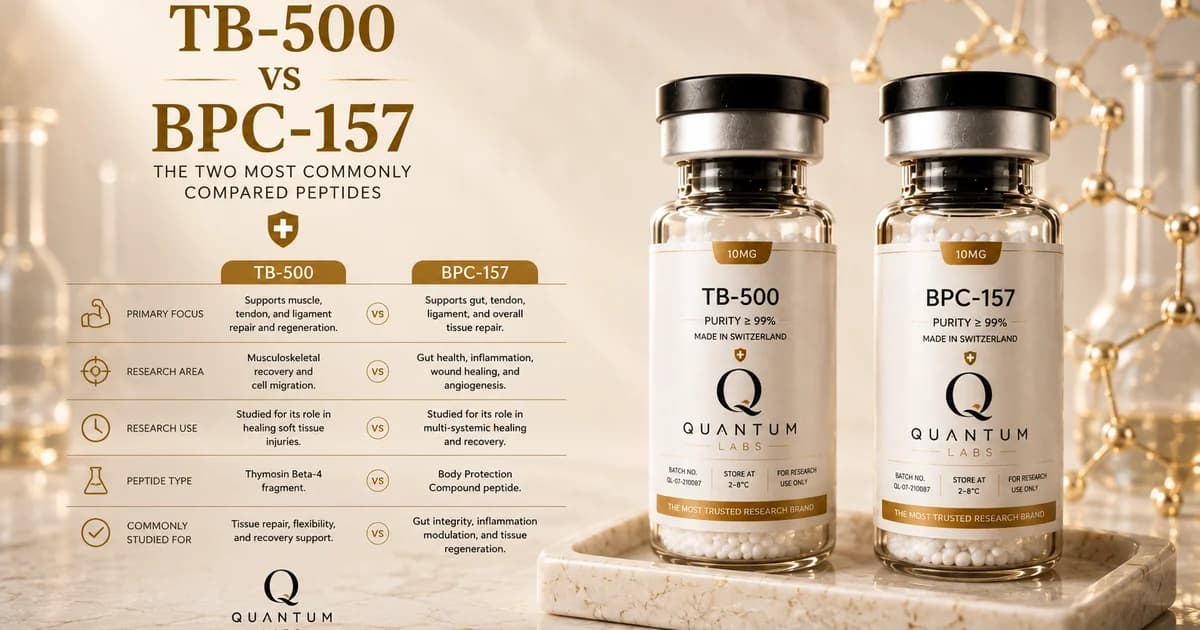
TB-500 and BPC-157 appear together in nearly every contemporary discussion of research-grade tissue-repair peptides. They're often grouped because both are extensively studied in soft-tissue repair models — but the grouping flattens an important detail: the two compounds target fundamentally different molecular pathways. The reason they're used together in research isn't redundancy. It's complementarity.
This article walks through both peptides individually, examines where the mechanisms overlap and where they diverge, and explains why combined-administration research is so common despite the surface-level similarity.
What is TB-500?
TB-500 is a synthetic fragment of the naturally occurring 17-amino-acid sequence within the larger 43-amino-acid protein thymosin β-4 (TB-4). Specifically, TB-500 contains the LKKTETQ actin-binding domain — the functional region of full-length thymosin β-4 that interacts with G-actin (monomeric actin) in the cytoplasm of every animal cell. The synthetic short fragment is more practical for research-grade production than full-length thymosin β-4 and is the form most extensively characterised in published pre-clinical literature.
TB-500 distributes systemically after administration in animal studies — once in circulation, it doesn't stay localised to the injection site. This systemic distribution is a defining characteristic of the compound and is why research on TB-500 tends to focus on injuries distant from the administration site as much as local repair models.
TB-500 mechanism: actin sequestration
The core mechanism is actin binding. TB-500 sequesters G-actin (free actin monomers) in the cytoplasm, modulating the equilibrium between G-actin and F-actin (the polymerised form that makes up the cytoskeleton). This modulation is hypothesised to influence cell motility, cell migration, and the cytoskeletal remodelling that accompanies wound repair.
Downstream effects characterised in research models include accelerated endothelial cell migration (related to angiogenesis), modulation of inflammatory cell behaviour, and influence on the differentiation of progenitor cells toward repair phenotypes.
What is BPC-157?
BPC-157 is a 15-amino-acid synthetic pentadecapeptide derived from a protective protein originally isolated from human gastric juice. Unlike TB-500, BPC-157 is not a fragment of a larger natural protein in the sense that its sequence corresponds to a discrete biologically meaningful functional domain — it is a synthetic stabilised analogue of a gastroprotective compound, and its research history began with gastrointestinal models before expanding to the broader tissue-repair field.
BPC-157 mechanism: NO pathway + VEGF
BPC-157's mechanism in research models centres on the nitric oxide (NO) system and VEGF-driven angiogenesis. Research has shown that BPC-157 modulates NO signalling in injured tissue and upregulates growth hormone receptor expression in tendon fibroblasts — the connective-tissue cells responsible for collagen production. Where TB-500 acts on the cytoskeleton, BPC-157 acts more directly on the vascular and collagen-synthesis sides of the repair cascade.
BPC-157 also distributes systemically in animal studies but appears to have particularly strong localised effects at injury sites. The research literature on BPC-157 is more weighted toward localised tissue-repair endpoints (tendon attachment, ligament strength, gut barrier function) than TB-500's broader systemic-repair literature.
Side-by-side: how they differ
Pulling the threads together — where the two compounds overlap and where they diverge:
Origin
- TB-500: Synthetic 17-residue fragment of natural thymosin β-4.
- BPC-157: 15-residue synthetic analogue derived from a gastric protective protein.
Primary mechanism
- TB-500: Actin sequestration and cytoskeletal remodelling.
- BPC-157: NO-pathway modulation and VEGF-driven angiogenesis.
Research focus in the literature
- TB-500: Systemic repair models — cell migration, angiogenesis, distributed cytoskeletal remodelling.
- BPC-157: Localised tissue-repair models — tendon-to-bone attachment, ligament strength, gut barrier integrity.
Half-life
- TB-500: Longer effective duration after administration in research models, reflecting its distribution and intracellular activity.
- BPC-157: Shorter circulating half-life but sustained tissue effects at the local repair site.
Why protocols often combine them
The complementarity is the answer. Tissue repair is a multi-stage cascade — vascular response, inflammatory modulation, cell migration, proliferation, collagen synthesis, remodelling. No single research peptide is studied across the full cascade with equal weight. BPC-157 dominates the vascular/angiogenic and collagen-synthesis sides; TB-500 dominates the cell-migration and cytoskeletal-remodelling sides. Stacking them in research is a way to cover more of the cascade in a single study design.
The combined-administration approach is so common that some suppliers — including Quantum Labs — pre-portion the two compounds into a single research-stack vial. Our BPC-157 + TB-500 research stack supplies both at standard research-cycle volumes for paired-administration protocols.
Typical research doses in published literature
Published research has used wide dose ranges depending on the injury model, species, and route of administration:
TB-500 in research
Most published systemic rodent models have used TB-500 doses in the 2-10 mg/kg range. Research on localised injection at specific tissue sites has used smaller absolute amounts. Human therapeutic dosing is not established.
BPC-157 in research
Most published rodent tendon-healing models have used BPC-157 doses around 10-20 μg/kg per day. Gut-barrier research and some vascular-repair models have used substantially higher doses. Human therapeutic dosing is not established.
Stack research dosing
In combined-administration protocols, each compound is typically dosed within its individual published range — the stack doesn't reduce per-compound dosing, it just means both pathways are activated simultaneously. Researchers designing combined protocols should reference primary literature for the specific tissue model under study.
Reconstitution and storage for both compounds
Both TB-500 and BPC-157 ship as lyophilised powder in sealed vials. Reconstitution with bacteriostatic water (sterile water with 0.9% benzyl alcohol preservative) produces a working solution. The standard handling protocol:
- Store unopened vials refrigerated at 2-8°C for long-term shelf life.
- Reconstitute with a volume of bacteriostatic water sized to your research-protocol working concentration.
- Store the reconstituted solution refrigerated and use within ~30 days.
- Avoid freeze-thaw cycles — the temperature swing damages peptide structure and reduces active compound concentration.
Legal status in Australia
Both compounds are restricted for compounded human therapeutic supply in Australia. The TGA classifies them in a way that restricts pharmacy-compounded preparations for human use, but research-grade supply for laboratory and pre-clinical work remains legal when supplied without therapeutic representation.
The distinction is real and important: a registered Australian pharmacy compounding BPC-157 for human prescription operates under different rules to a research supplier providing lyophilised material for laboratory study. Quantum Labs falls in the second category. Material is supplied for research use only, with no therapeutic claims, packaged as research material and clearly labelled as such.
Quality standards: why HPLC purity matters for both
Both TB-500 and BPC-157 are synthetic peptides produced by solid-phase peptide synthesis. The process is reliable but imperfect — every step has a coupling efficiency below 100%, which means longer peptides accumulate deletion sequences (peptides missing one or more residues). For TB-500 (17 residues) and BPC-157 (15 residues), purity verification is essential.
Quantum Labs verifies every batch of both compounds against ≥99% HPLC purity. Mass spectrometry confirms identity — the molecular weight matches the expected sequence. Certificates of analysis are batch-traceable and available on request. This is the baseline standard for research-grade peptides; anything less introduces noise into dose-response measurements.
Stack the two for research. Both compounds ship from Australian stock with batch certificates of analysis. View the BPC-157 + TB-500 research stack → or order them individually: BPC-157 / TB-500.