
Peptide Dosage Calculator: Working Concentration Math | Quantum Labs
Practical research-peptide dose-volume math — reconstitution, working concentration, and worked examples for BPC-157, TB-500, MOTS-c, CJC-1295 + Ipamorelin, GHK-Cu.
Why peptide dosage calculators exist
Research peptides ship as lyophilised powder of a specific mass (often 5 mg or 10 mg per vial). The research protocol a researcher is following typically specifies a dose in micrograms (μg) or milligrams (mg). And the syringe used to deliver the dose is marked in millilitres (mL) or insulin units (where 100 units = 1 mL). The dosage calculator problem is mapping between these three units: vial mass, target dose, and syringe volume.
The math is straightforward once you understand the working concentration concept — the bridge that connects the mass in the vial to the volume on the syringe. This article walks through the underlying math, gives worked examples for the most-searched compounds (BPC-157, TB-500, MOTS-c, CJC-1295 + Ipamorelin, GHK-Cu), and covers the common mistakes that produce dose errors.
Framing: this is research-protocol math for laboratory work. Quantum Labs supplies research-grade compounds for research use only. For clinical dosing questions related to personal use, a qualified medical practitioner is the right referee.
The core formula
Every peptide dosage calculation comes down to one equation:
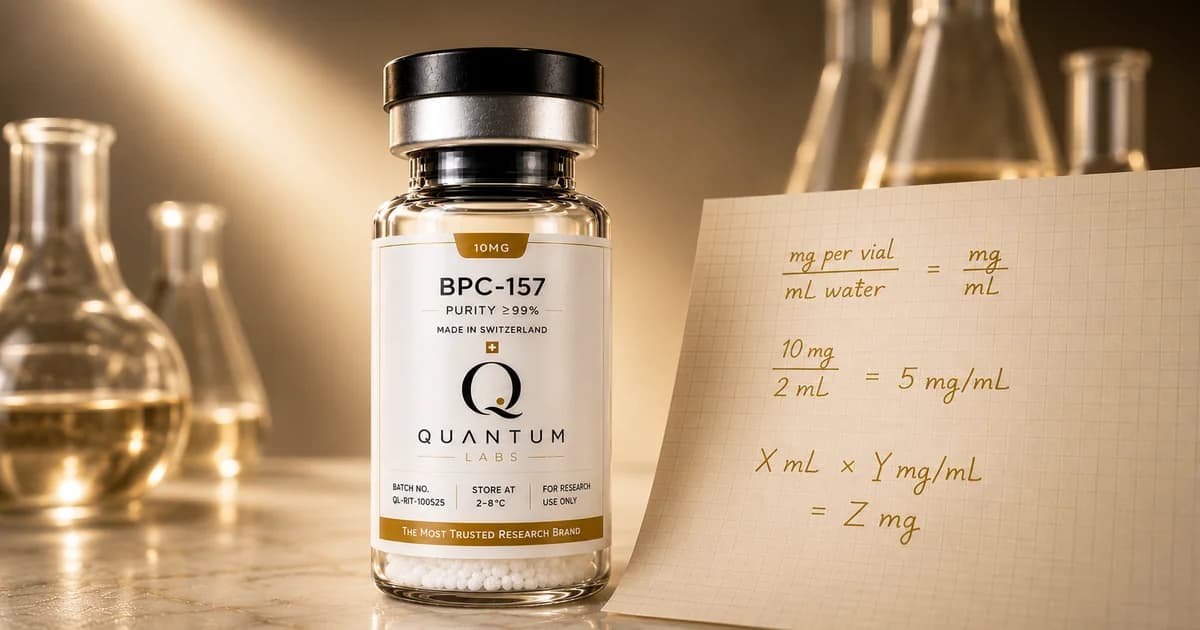
Dose volume (mL) = Target dose ÷ Working concentration
The working concentration is set by how much diluent (typically bacteriostatic water) you add to the lyophilised vial. Adding less diluent gives a higher concentration; adding more diluent gives a lower concentration. There's no “correct” volume — researchers choose a reconstitution volume that produces a working concentration that makes their target-dose math straightforward.
Step 1: Calculate the working concentration
The working concentration is the mass of peptide per volume of reconstituted solution. The formula:
Working concentration = Vial mass ÷ Diluent volume
For a 5 mg vial reconstituted with 2 mL of bacteriostatic water:
5 mg ÷ 2 mL = 2.5 mg/mL (or 2,500 μg/mL)
The working concentration stays constant throughout the vial's usable life, so this calculation only needs to happen once per vial — at reconstitution. Recording the working concentration on the vial label (e.g. “2,500 μg/mL — reconstituted DD/MM”) eliminates one source of error when drawing doses later.
For more on the reconstitution mechanics themselves, see our reconstitution guide.
Step 2: Calculate the dose volume
Once you know the working concentration, calculating the dose volume for any target dose is straightforward division.
Using the 2,500 μg/mL working concentration from above, and a target dose of 250 μg:
250 μg ÷ 2,500 μg/mL = 0.1 mL
On a standard insulin syringe (100 units = 1 mL), 0.1 mL = 10 units. The math is consistent: at this working concentration, every 25 μg of target dose maps to 1 insulin unit. So a 500 μg dose would be 20 units, a 750 μg dose would be 30 units, and so on.
Worked example: BPC-157 (5 mg vial)
Most BPC-157 research dosing in published literature falls in the 250-500 μg range. Working through the math for a standard 5 mg vial:
Option A: 2 mL diluent
- Working concentration: 5 mg ÷ 2 mL = 2.5 mg/mL = 2,500 μg/mL
- 250 μg dose = 0.1 mL = 10 units
- 500 μg dose = 0.2 mL = 20 units
- Vial covers 20 × 250 μg doses or 10 × 500 μg doses
Option B: 1 mL diluent (higher concentration)
- Working concentration: 5 mg ÷ 1 mL = 5 mg/mL = 5,000 μg/mL
- 250 μg dose = 0.05 mL = 5 units
- 500 μg dose = 0.1 mL = 10 units
Higher concentration means smaller dose volumes, which can be useful for precision at low target doses but harder to measure accurately on standard insulin syringes (1 unit increments). The 2 mL reconstitution is the more common research-protocol choice for BPC-157.
Research-grade BPC-157 is available from the BPC-157 product page.
Worked example: TB-500 (5 mg vial)
Published TB-500 research has used wider dose ranges, typically 2-10 mg/kg in rodent systemic models. For research protocols using a 2 mg dose:
- 5 mg vial reconstituted with 2 mL = 2,500 μg/mL
- 2 mg dose = 2,000 μg ÷ 2,500 μg/mL = 0.8 mL = 80 units
- Vial covers 2.5 × 2 mg doses (so 1 vial = ~1 dose with some waste, or 2 vials per dose if using full 2 mg)
The TB-500 dose volumes are typically much larger than BPC-157 because the research dose range is higher. Lower concentrations (more diluent) generally don't help here — they just produce even larger injection volumes.
Worked example: BPC-157 + TB-500 stack
Our BPC-157 + TB-500 research stack supplies the two compounds in separate vials, each reconstituted independently with bacteriostatic water. Standard reconstitution and dose-volume math:
- BPC-157 vial: reconstitute with 2 mL → 2,500 μg/mL. Target 250 μg = 0.1 mL = 10 units.
- TB-500 vial: reconstitute with 2 mL → 2,500 μg/mL. Target 2 mg = 0.8 mL = 80 units.
- Combined research-protocol administration: draw each dose from its respective vial. Don't mix the reconstituted solutions — keep them in their original vials to maintain identity and shelf-life tracking.
Worked example: MOTS-c (10 mg vial)
MOTS-c research dosing varies substantially by study design. For a 5 mg target dose from a 10 mg vial:
- 10 mg vial reconstituted with 2 mL = 5,000 μg/mL = 5 mg/mL
- 5 mg dose = 1 mL = 100 units (full insulin syringe)
- Vial covers 2 × 5 mg doses
For smaller target doses (1-2 mg range), the same concentration scales down predictably: 1 mg = 0.2 mL = 20 units; 2 mg = 0.4 mL = 40 units.
Worked example: CJC-1295 + Ipamorelin
The combined vial supplies both peptides — typically 2 mg CJC-1295 + 2 mg Ipamorelin in a single vial. Reconstituted with 2 mL of bacteriostatic water:
- Working concentration: 4 mg total peptide ÷ 2 mL = 2 mg/mL combined (1 mg/mL of each compound)
- For a research dose of 100 μg of each compound: 100 μg ÷ 1,000 μg/mL = 0.1 mL = 10 units of the combined solution.
- Vial covers 20 × 100 μg-of-each doses.
Research-grade CJC-1295 + Ipamorelin is available from the CJC-1295 + Ipamorelin product page.
Worked example: GHK-Cu (50 mg vial)
GHK-Cu vials are typically larger by mass (50 mg or 100 mg) because the cosmetic-formulation and topical-research delivery formats use larger absolute amounts than systemic injection. For a 50 mg GHK-Cu vial reconstituted with 5 mL of bacteriostatic water (a higher diluent volume because the vial mass is larger):
- Working concentration: 50 mg ÷ 5 mL = 10 mg/mL
- 5 mg topical research dose = 0.5 mL
- For 1% topical formulation by volume, mix 1 mL of working solution (10 mg) into 100 mL of carrier — produces a 100 μg/mL (0.01%) topical solution. Or 10 mL of 10 mg/mL into 100 mL carrier produces 1 mg/mL (0.1%).
For topical research, the concentration math is generally based on % weight/volume rather than raw working concentration, and the carrier (cream, gel, lotion base) is part of the formulation. Subcutaneous research dose calculations use the working-concentration approach directly like any other peptide.
The most common dosage-calculation mistakes
Several recurring errors in research-protocol dose calculations:
- Mixing μg and mg without converting. 1 mg = 1,000 μg. Forgetting the conversion produces 1,000-fold dose errors. Always note units explicitly in the working calculation.
- Confusing units and mL on insulin syringes. 100 units = 1 mL. The unit markings are typically more precise than the mL markings on insulin syringes, so calculating dose in mL and then converting to units (× 100) gives the most precise read.
- Using the wrong vial mass. Different suppliers ship different vial sizes for the same compound. Always verify the actual vial mass (per the supplier's labelling and certificate of analysis) before reconstituting — don't assume.
- Forgetting the reconstitution volume. The working concentration depends on how much diluent was added. Label the vial with the working concentration after reconstitution so this information stays attached to the physical vial.
- Mixing different compounds in a single syringe. Don't draw two different peptides into one syringe. Each compound has its own working concentration; combined drawing introduces concentration ambiguity. Use separate syringes (or separate draws into the same syringe in sequence).
- Not double-checking with a second person where possible. For research protocols where dose accuracy is critical to the experimental outcome, a second researcher verifying the working concentration and dose volume calculations independently catches most arithmetic errors.
Quick reference: common reconstitution-to-dose mappings
For the most-common research-peptide reconstitution patterns:
5 mg vial reconstituted with 2 mL → 2,500 μg/mL
- 100 μg = 0.04 mL = 4 units
- 250 μg = 0.1 mL = 10 units
- 500 μg = 0.2 mL = 20 units
- 1,000 μg (1 mg) = 0.4 mL = 40 units
5 mg vial reconstituted with 1 mL → 5,000 μg/mL
- 100 μg = 0.02 mL = 2 units
- 250 μg = 0.05 mL = 5 units
- 500 μg = 0.1 mL = 10 units
- 1,000 μg (1 mg) = 0.2 mL = 20 units
10 mg vial reconstituted with 2 mL → 5,000 μg/mL
- 500 μg = 0.1 mL = 10 units
- 1 mg = 0.2 mL = 20 units
- 2 mg = 0.4 mL = 40 units
- 5 mg = 1 mL = 100 units (full syringe)
Tracking working concentration on the vial
A practical research-protocol habit that prevents most dose errors: label the vial immediately after reconstitution with three pieces of information:
- Working concentration in clearly stated units (e.g. “2,500 μg/mL”).
- Reconstitution date for tracking against the ~30-day usable window.
- Batch identifier from the original lyophilised vial label, so the working solution can be traced back to its certificate of analysis if needed.
A printed sticker or even masking tape with permanent marker works fine. The point is keeping the calculation context attached to the physical vial rather than depending on memory or paper notes that may not be present at dose time.
Where this fits in the broader research framework
Working concentration math is the most error-prone step in research peptide handling — small arithmetic mistakes produce 10-fold or 100-fold dose errors that contaminate research results. For research-supply contexts, the calculations here apply directly. For clinical or therapeutic dosing questions, the calculation framework is similar but the clinical considerations (patient-specific factors, monitoring, drug interactions) are separate questions that belong with a qualified medical practitioner.
For the full reconstitution mechanics, our reconstitution guide covers the physical handling. For an overview of cycle design and research-protocol structure, see our peptide cycling 101 guide.
Research peptides + bacteriostatic water from Australian stock. Vial sizes specified per product, batch-traceable to certificates of analysis. Browse the catalogue →