
Peptides Used in Fat Loss Research | Retatrutide, MOTS-c, AOD 9604 | Quantum Labs
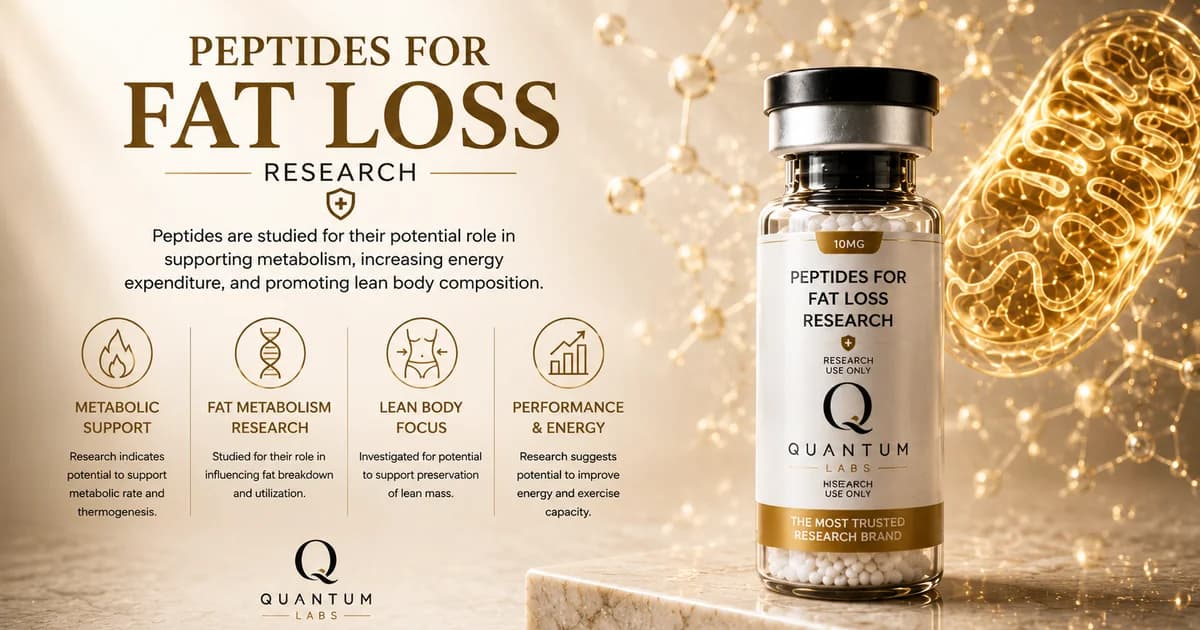
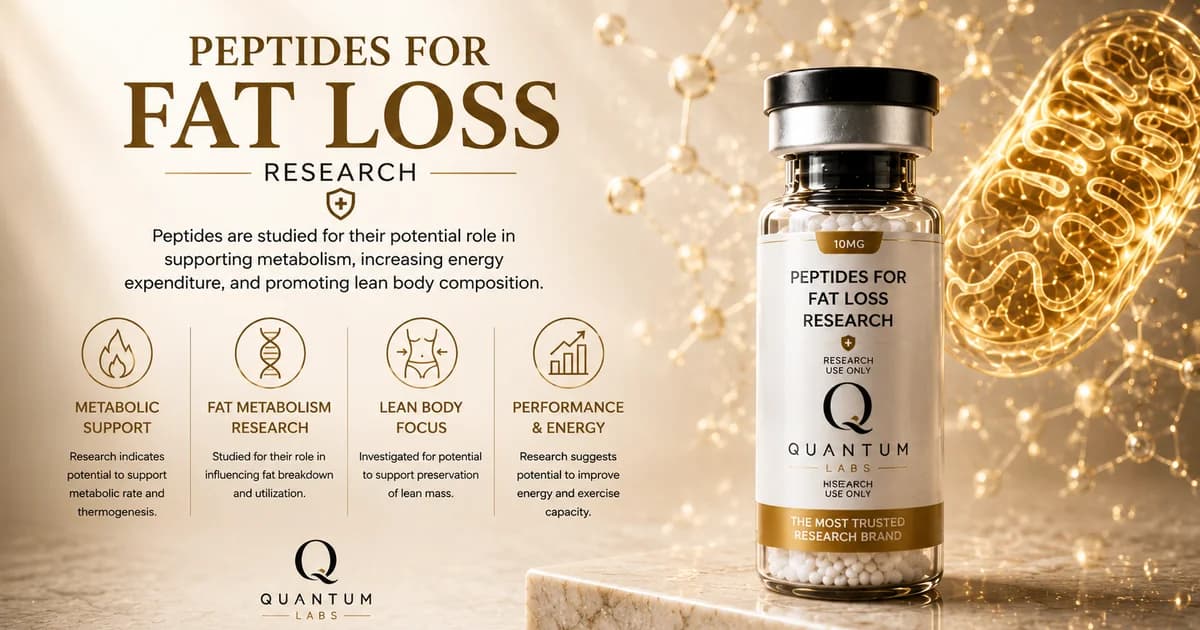
Peptides used in fat loss research — Retatrutide, tirzepatide, MOTS-c, AOD 9604, 5-Amino-1MQ, L-Carnitine. What the literature actually examines.
The research landscape has shifted
Research interest in peptide-mediated fat loss has accelerated dramatically over the past five years. The clinical success of GLP-1 receptor agonists in Type 2 diabetes and obesity populations — first semaglutide (marketed as Ozempic and Wegovy), then tirzepatide (marketed as Mounjaro) — opened a research pipeline that now extends well beyond the original approved indications.
For Australian researchers studying peptides for fat loss, the landscape now includes approved therapeutics (which require a prescription and pharmacy supply), research-grade analogues (which sit in a different regulatory category and are available for laboratory use), and adjunctive compounds (which target peripheral pathways and are studied alongside the headline incretin compounds). This article walks through the most-studied compounds in each category and what the published research actually examines.
The incretin-receptor family
The dominant story in contemporary fat-loss peptide research is the incretin-receptor family — glucagon-like peptide-1 (GLP-1) and glucose-dependent insulinotropic polypeptide (GIP) receptor agonists, with newer compounds adding glucagon receptor activity. These compounds are studied for their effects on appetite regulation, gastric emptying, insulin sensitivity, and body composition.
Semaglutide
A long-acting GLP-1 receptor agonist. Marketed as Ozempic (Type 2 diabetes) and Wegovy (chronic weight management) in jurisdictions where it has regulatory approval. Acts by slowing gastric emptying and modulating central appetite regulation in the hypothalamus. The STEP and SUSTAIN trial programmes generated the bulk of the human clinical data. Semaglutide is a prescription medicine; research-grade semaglutide for laboratory use sits in a separate regulatory category and is not the focus of this article.
Tirzepatide (Mounjaro)
A dual GLP-1 / GIP receptor agonist. Activating both incretin receptors simultaneously produces a larger effect on body weight in clinical trials than semaglutide's single-receptor activity, at least in the head-to-head comparisons published to date. Marketed as Mounjaro for diabetes and (in some jurisdictions) Zepbound for weight management. Like semaglutide, it's a prescription medicine. Research-grade tirzepatide is supplied for laboratory work only.
Retatrutide
Retatrutide is the newer generation: a tri-agonist that activates GLP-1, GIP, AND glucagon receptors simultaneously. The added glucagon-receptor activity is the distinguishing pharmacological feature, and pre-clinical research suggests it may produce metabolic effects beyond what dual-agonists achieve. Retatrutide is not an approved therapeutic in Australia — it remains in clinical investigation in the jurisdictions where it's being studied — and is available as a research-grade compound for laboratory use.
The most-searched comparisons in the research community are retatrutide vs tirzepatide and retatrutide vs mounjaro. The short version: tirzepatide (sold as Mounjaro) targets two of the three relevant receptors; retatrutide targets all three. That added glucagon-receptor activity is the focus of the differentiating research literature.
Mitochondrial peptides: MOTS-c
The incretin-receptor family targets appetite and central metabolic regulation. Mitochondrial peptides target the cellular side of the question — what happens once fatty acids enter the cell and need to be oxidised. The most-studied compound in this category is MOTS-c.
MOTS-c is unusual because it's encoded within the mitochondrial 12S ribosomal RNA gene — not in the nucleus, like nearly every other peptide. It is one of the few characterised mitochondrially-derived peptides and has become a focal point of metabolic-regulation research. Published studies cover its role in AMPK pathway activation, glucose homeostasis, insulin sensitivity, mitochondrial biogenesis, and fatty-acid oxidation. The compound is hypothesised to function as a regulator of cellular metabolic flexibility.
In research designs studying peptides for fat loss, MOTS-c is often paired with incretin-pathway compounds — the combination covers both the central appetite-and-uptake side (incretin family) and the cellular oxidation side (MOTS-c), which are the two rate-limiting steps in the broader fat-oxidation cascade.
HGH fragments: AOD 9604
AOD 9604 is a synthetic 16-amino-acid fragment of human growth hormone, specifically corresponding to residues 176-191 at the C-terminal end of the hGH molecule. It is one of the most-studied HGH-fragment research compounds in adipose-tissue and lipolysis literature.
The research interest centres on a specific question: can you preserve hGH's lipolytic activity (its effect on fatty-acid release from adipose tissue) while eliminating the broader growth-promoting and insulin-sensitivity effects of the full-length hormone? AOD 9604 is the structural answer that the research community has been examining for two decades. Pre-clinical studies have shown the fragment retains measurable lipolytic activity without the IGF-1 elevation or insulin-sensitivity changes characteristic of full hGH.
The compound is studied via subcutaneous administration in most published designs. Australian researchers can source AOD 9604 as a lyophilised research-grade compound from local stock.
NNMT inhibitors: 5-Amino-1MQ
A different angle on fat-loss research targets the enzyme nicotinamide N-methyltransferase (NNMT). NNMT methylates nicotinamide using S-adenosyl methionine as the methyl donor, and elevated NNMT activity has been associated with adipocyte dysfunction, reduced metabolic flexibility, and impaired cellular methyl-donor balance in research models. Inhibiting NNMT is therefore studied as a way to restore healthier adipocyte function.
5-Amino-1MQ is a small molecule (not a peptide) and a selective NNMT inhibitor. The research community uses it primarily as a probe — a tool to interrogate NNMT-dependent pathways and characterise the downstream effects of NNMT inhibition. It's a different mechanism to the incretin family or the HGH fragments, and is studied as a complementary research tool rather than as a substitute for those pathways.
Adjunctive support: L-Carnitine
Fat oxidation research often pairs the headline peptides with foundational support compounds — molecules studied for decades whose role in the cellular fat-oxidation pathway is well-characterised. L-Carnitine is the canonical example. It's the cellular cofactor that transports long-chain fatty acids across the inner mitochondrial membrane for β-oxidation — without adequate carnitine, fatty acids can't enter the mitochondrial matrix where they'd be oxidised. Carnitine research is foundational to the broader fat-oxidation literature.
In structured fat-loss research stacks, L-Carnitine functions as a support compound — ensuring the rate-limiting step of mitochondrial fatty-acid uptake isn't the bottleneck.
The Quantum Labs Fat Loss Protocol
Our Fat Loss Protocol pairs three of these compounds into a structured 8-week research kit: Retatrutide (the tri-agonist), MOTS-c (the mitochondrial peptide), and L-Carnitine (the adipose-uptake support compound). The combination is designed for research applications investigating multi-pathway metabolic regulation — appetite + cellular oxidation + transport cofactor — in a single protocol design.
All three compounds in the kit are HPLC-verified to ≥99% purity, ship together from Australian stock, and are supplied for laboratory research use only. The 8-week cycle structure mirrors common research-cycle lengths used in published incretin-pathway and mitochondrial-function literature.
Compounds we don't supply (and why)
A few notes on what's deliberately absent from this discussion: semaglutide (Ozempic, Wegovy) and tirzepatide (Mounjaro, Zepbound) are prescription medicines in Australia and require pharmacy supply through a valid prescription. Quantum Labs is not a pharmacy and does not supply prescription medicines. Researchers asking about research-grade analogues of these compounds in laboratory contexts should be aware that the regulatory category is distinct from prescription supply, and the framework for legitimate research use differs from individual therapeutic access.
Anything that lands in this article is supplied as research material with no therapeutic representation. Researchers studying these compounds should reference primary literature for protocol-specific dosing and consult qualified medical practitioners for clinical questions.
Quality and purity standards
Research outcomes depend on input quality. Synthetic peptide compounds — including AOD 9604 and MOTS-c — are produced by solid-phase synthesis that produces deletion sequences as byproducts. Larger compounds like retatrutide require even more careful purity verification because the synthesis is more complex. Small-molecule compounds like 5-Amino-1MQ are produced by organic synthesis and have their own purity-verification requirements.
Every Quantum Labs compound — peptide or small molecule — is HPLC-verified to ≥99% purity, with identity confirmed by mass spectrometry. Certificates of analysis are batch-traceable and available on request. This baseline standard is what separates research-grade material from unverified bulk chemical supply.
Source fat-loss research compounds. The Quantum Labs Fat Loss Protocol bundles Retatrutide, MOTS-c, and L-Carnitine at cycle volume; individual compounds are available in the catalogue. View the protocol →