
BPC-157 Australia: What the Research Actually Shows | Quantum Labs
What the BPC-157 research actually shows — mechanism, dosing, side effects, legal status in Australia, and how the literature frames this research peptide.
What is BPC-157?
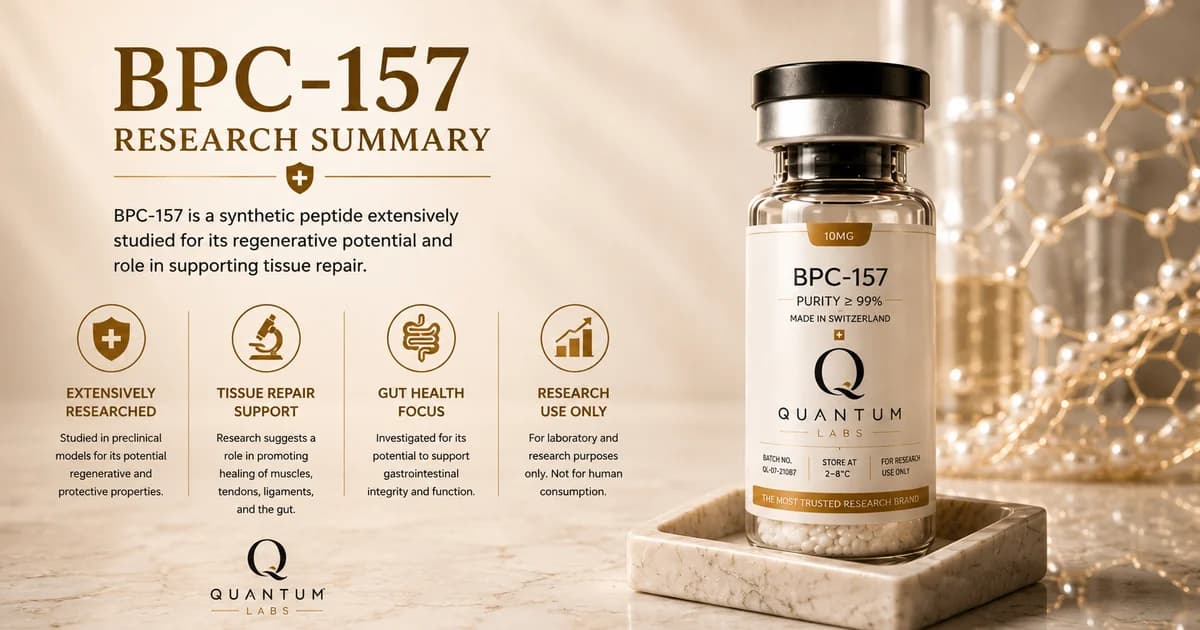
BPC-157 — Body Protection Compound 157 — is a synthetic pentadecapeptide derived from a 15-amino-acid sequence found in a larger protective protein originally isolated from human gastric juice. Over the past two decades it has become one of the most extensively studied research peptides in the musculoskeletal and gastrointestinal literature, with hundreds of peer-reviewed publications examining its role in tissue repair models. For Australian researchers, BPC-157 is supplied as research-grade material — sealed lyophilised vials, HPLC-verified to a minimum 99% purity specification, shipped domestically from Australian stock.
Despite its long research history, BPC-157 sits in a regulatory grey area in Australia: the Therapeutic Goods Administration (TGA) has restricted its use in compounded therapeutic preparations, but it remains legally available for research and laboratory use when supplied without therapeutic representation. The distinction matters — research-grade supply and compounded therapeutic supply (what a registered pharmacy provides on prescription) sit in different regulatory categories, with different rules around claims, packaging, and intended use.
Mechanism of action in research literature
BPC-157's mechanism is the most-studied aspect of the peptide and the area where the research literature is most unified. Three pathways appear repeatedly in published work:
1. The nitric oxide system
BPC-157 modulates the nitric oxide (NO) system in research models. Studies have demonstrated that the peptide can counteract the effects of NO synthase inhibitors and influence downstream vascular signalling. The NO-pathway interaction is one of the most consistent findings across published rodent studies and is hypothesised to underlie several of the tissue-repair effects observed in animal models.
2. Growth hormone receptor expression in tendon fibroblasts
Research has shown BPC-157 upregulates growth hormone receptor expression in tendon fibroblasts — the connective-tissue cells responsible for collagen production. The upregulation is believed to amplify the local response to growth-hormone signalling at the site of tendon injury, accelerating the migration, proliferation, and survival of repair cells. This mechanism is one of the key reasons BPC-157 has attracted interest in tendon-injury research models.
3. VEGF-driven angiogenesis
Vascular endothelial growth factor (VEGF) signalling has been implicated in BPC-157's effects on new blood vessel formation in injured tissue. Animal studies have shown accelerated angiogenesis at injury sites, which is foundational to the broader repair cascade — without adequate blood supply, tissue regeneration is rate-limited regardless of other repair-pathway activity.
What the research literature examines
Published BPC-157 research spans a remarkably broad range of tissue types and injury models. The most well-cited research areas include:
- Tendon-to-bone healing — Achilles and patellar tendon models in rodents, with measured outcomes including biomechanical strength, collagen organisation, and histological repair markers.
- Muscle crush injury — recovery rate studies in standardised crush-injury models, with outcomes measured in functional and histological terms.
- Gut barrier integrity — research on BPC-157 in inflammatory bowel models, where the peptide is studied for its effects on mucosal repair and barrier function under inflammatory stress.
- Vascular regeneration — ischemia and reperfusion injury models, examining BPC-157's effects on the formation of new vasculature in compromised tissue.
- Ligament and soft-tissue collagen synthesis — direct measurements of collagen production and organisation in soft-tissue repair models.
Research dosage in published literature
Published rodent studies have used BPC-157 doses spanning approximately 10 μg/kg to 250 μg/kg, with the most common tendon-healing models clustering around 10-20 μg/kg per day delivered subcutaneously or intraperitoneally. Higher doses have been used in gut-barrier and vascular-repair models, but the literature has not converged on a single “optimal” dose because the optimum varies with the injury model and measurement endpoint.
Human dosing is not established. BPC-157 has not undergone the regulatory clinical trial process required to establish a human therapeutic dose, and we make no recommendations regarding human use. Researchers should reference primary literature for the specific protocol they are designing.
Documented side effects in research literature
In pre-clinical rodent studies, BPC-157 has demonstrated an unusually wide tolerability margin. Studies running at doses substantially above the typical therapeutic-investigation range have not produced significant toxicity signals in the published literature. This favourable tolerability profile is one of the reasons the peptide has attracted research interest across so many tissue types.
However, long-term human safety data is not available. BPC-157 has not undergone human regulatory trials, so conclusions about chronic exposure in humans cannot be drawn from the rodent literature alone. Researchers and individuals asking about side effects in a human context should consult a qualified medical practitioner.
Oral vs injected: what does the research say?
A distinctive feature of BPC-157 that sets it apart from most research peptides is its stability in human gastric juice — unsurprising given the parent molecule's origin in gastric secretions. This stability has driven research interest in oral as well as injected administration formats, with published studies examining both delivery routes in rodent and in-vitro models.
Injected (subcutaneous or intraperitoneal) delivery remains the most common research format because dosing is more predictable and bioavailability is better characterised. Oral delivery is studied for gut-localised research questions and for ease-of-handling in extended-duration protocols. Our lyophilised supply can be reconstituted for either format — researchers determine the appropriate delivery method for their specific study design.
BPC-157 in stacked research protocols
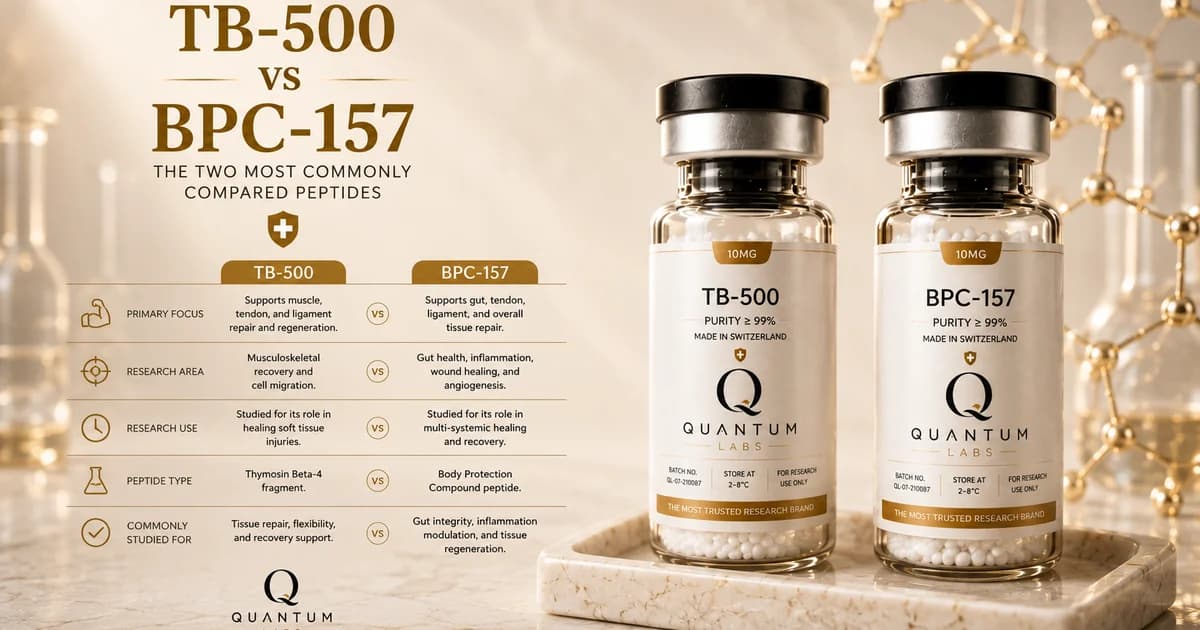
BPC-157 is most often studied in combination with TB-500 — a synthetic fragment of the natural protein thymosin β-4. The two compounds target complementary tissue-repair pathways: BPC-157 acts predominantly through nitric oxide and VEGF signalling, while TB-500 acts on actin sequestration and cell migration. Combining them in research is common precisely because the mechanisms are non-overlapping — the combined protocol covers both the angiogenic and cytoskeletal sides of the repair cascade in a single study design.
Quantum Labs supplies BPC-157 individually and as a pre-portioned BPC-157 + TB-500 research stack sized for the 8-week research cycle used in most published tendon and soft-tissue repair models. Both compounds in the stack are independently HPLC-verified to ≥99% purity.
Purity standards: why ≥99% matters in BPC-157 research
Research outcomes are only as reliable as the compounds that produce them. BPC-157 is a 15-amino-acid synthetic, which means it's in a length range where solid-phase peptide synthesis routinely produces deletion peptides — sequences missing one or more residues — as byproducts. A 95%-pure BPC-157 sample can contain 5% of fragments that are structurally related but pharmacologically distinct, which becomes noise in any dose-response measurement.
Quantum Labs verifies every batch by high-performance liquid chromatography against a ≥99% purity specification. Identity is confirmed by mass spectrometry — the molecular weight measurement that confirms the peptide on the label is the peptide in the vial. Certificates of analysis are batch-traceable and available on request.
Storage and reconstitution
Lyophilised BPC-157 is stable at room temperature for several weeks in sealed unopened vials. For longer-term storage, refrigeration at 2-8°C extends shelf life to several months without measurable degradation. Once reconstituted with bacteriostatic water, the working solution should be stored refrigerated and used within approximately 30 days. Avoid freeze-thaw cycles, which can fragment the peptide backbone and reduce active compound concentration.
Bacteriostatic water — sterile water with 0.9% benzyl alcohol as a preservative — is the standard diluent for reconstituting research peptides intended for multi-use vials. Single-use delivery designs can use sterile water without preservative; multi-use designs need the bacteriostatic preservative to prevent bacterial growth in the working solution. We supply bacteriostatic water as a separate research supply.
The Australian research context
For Australian researchers, the practical questions around BPC-157 are: what is supplied, what purity standard, what shipping timeframes, and what documentation. Quantum Labs ships BPC-157 from Australian stock — typically 2-5 business days from payment confirmation depending on state. Lyophilised peptides are room-temperature stable for short periods, so cold-chain shipping is not required. Every batch ships with batch identifiers traceable to its certificate of analysis, available on request.
The compound is supplied for research use only and is not represented for human therapeutic use. Researchers are responsible for ensuring their work complies with applicable institutional, state, and federal requirements.
Source BPC-157 for research. Quantum Labs supplies HPLC-verified BPC-157 from Australian stock, with batch certificates of analysis available on request. View BPC-157 in the catalogue →