
Growth Hormone Peptides: A Research Guide | Quantum Labs
Growth hormone peptides — CJC-1295, Ipamorelin, Tesamorelin, and HGH. How GHRH analogues and ghrelin agonists are studied together in GH-axis research.
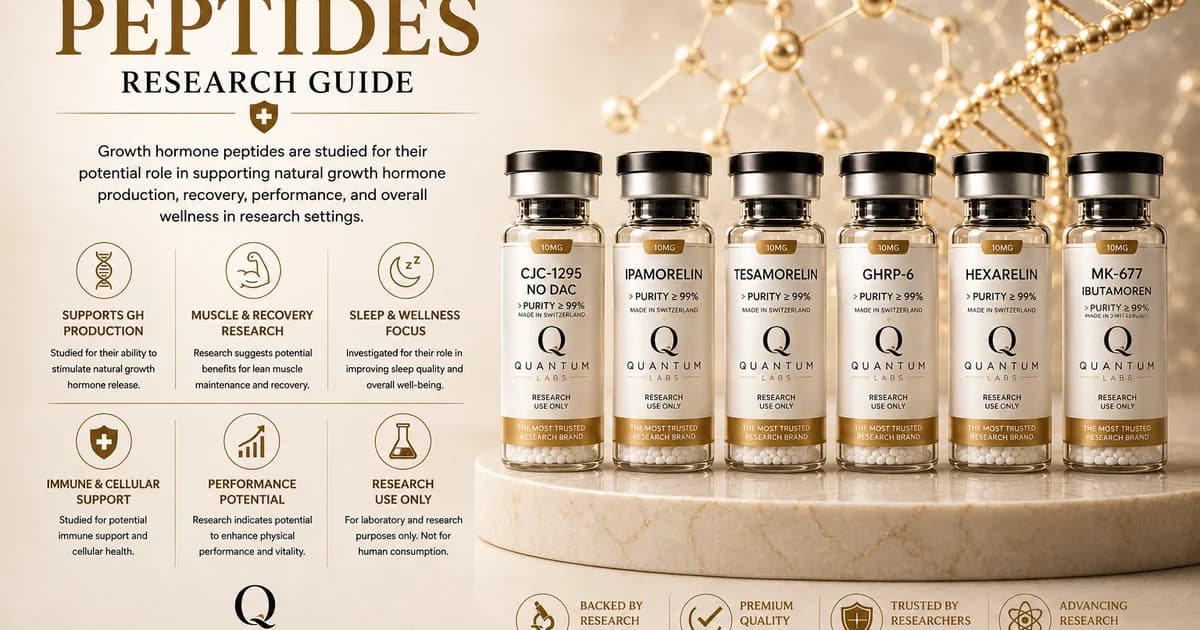
The growth-hormone peptide family
Direct supplementation with recombinant human growth hormone (HGH) is the oldest approach to investigating the GH-IGF-1 axis in research. It's also the most blunt — you get systemic growth-hormone signalling, but you lose the natural pulsatile rhythm that characterises healthy endogenous GH biology. That trade-off is why a family of research peptides known as growth-hormone secretagogues — compounds that stimulate the pituitary's own GH release rather than replacing it — has become the more nuanced research tool over the past two decades.
This guide walks through the GH peptide family as it appears in contemporary research literature: GHRH analogues (CJC-1295, Tesamorelin), ghrelin-receptor agonists (Ipamorelin), the rationale for combining them, and the role of direct HGH in research designs. For Australian researchers, every compound discussed here is available as research-grade material from local stock.
Two pathways to GH release
The pituitary releases growth hormone in response to two principal upstream signals: growth-hormone-releasing hormone (GHRH) from the hypothalamus, and ghrelin (acting via the growth-hormone secretagogue receptor, GHSR-1a) from the stomach. The two pathways are independent — they activate different receptors on pituitary somatotrophs — but they converge on the same downstream output: GH release.
This dual-pathway architecture is the key insight behind the research-peptide stacking practice that defines GH-axis research today. A GHRH-pathway compound and a ghrelin-pathway compound administered together don't compete for the same receptor — they activate independent receptors and produce a synergistic GH-release response that's larger than either compound alone.
GHRH analogues
GHRH analogues are synthetic peptides that mimic the natural GHRH from the hypothalamus. The two most-studied in research literature are CJC-1295 and Tesamorelin.
CJC-1295
CJC-1295 is a 30-amino-acid GHRH analogue. The shorter research variants (sometimes called modified GRF 1-29) are based on the active 1-29 fragment of natural GHRH, with modifications that enhance stability and resistance to enzymatic degradation. The compound exists in two main research forms:
- CJC-1295 without DAC: The shorter-acting form, with a half-life on the order of hours. Used in research designs that target acute pulsatile GH release.
- CJC-1295 with DAC: The Drug Affinity Complex variant binds plasma albumin, extending the half-life from hours to days. Used in research designs targeting sustained GHRH-receptor activity.
The without-DAC form is more common in published research because the shorter half-life better preserves the natural pulsatile GH rhythm. Sustained GHRH stimulation (the DAC variant) is studied in protocols designed to measure steady-state effects rather than acute pulses.
Tesamorelin
Tesamorelin is another stabilised GHRH analogue. It's the only GHRH analogue with regulatory approval in any jurisdiction — approved in the US for HIV-associated lipodystrophy under the brand name Egrifta. Its modifications give it a more sustained GHRH-mimicking profile than unmodified GHRH and a different pharmacokinetic profile to CJC-1295.
The most-searched comparison in research circles is tesamorelin vs ipamorelin — but the comparison is mixing categories. Tesamorelin is a GHRH analogue (binds the GHRH receptor); Ipamorelin is a ghrelin-receptor agonist (binds GHSR-1a). They target different receptors and are studied as complementary tools, not as alternatives. The more direct comparison is tesamorelin vs CJC-1295 — both GHRH analogues with different half-lives.
Ghrelin-receptor agonists: Ipamorelin
Ipamorelin is a synthetic peptide ghrelin-receptor agonist — it binds GHSR-1a (the same receptor as natural ghrelin and as the orally-active small molecule MK-677) and stimulates pituitary GH release. What distinguishes Ipamorelin in research literature is its selectivity.
Earlier-generation ghrelin agonists tend to produce a broader hormonal response — cortisol, prolactin, and aldosterone elevations alongside the GH release. Ipamorelin is described as a selective ghrelin agonist because it activates the GH pathway with minimal effect on cortisol, prolactin, or aldosterone. This selectivity has made it a preferred research tool for isolating GH-specific effects without the confounding hormonal noise.
For research designs studying the GH-IGF-1 axis specifically, this selectivity matters. A protocol intended to measure GH and IGF-1 dynamics is contaminated by simultaneous cortisol elevation — Ipamorelin avoids that confound.
Why CJC-1295 and Ipamorelin are paired in research
The CJC-1295 + Ipamorelin combination is by far the most common GH-secretagogue research pairing. The pairing is motivated by a specific experimental logic:
- CJC-1295 acts on the GHRH receptor — the “go” signal pathway from the hypothalamus.
- Ipamorelin acts on GHSR-1a — the ghrelin pathway from the stomach.
- Both pathways converge on pituitary somatotrophs but through independent receptors.
- Combined activation produces a larger pulsatile GH response than either compound alone, while preserving the pulsatile rhythm characteristic of healthy GH biology.
Quantum Labs supplies the combination as a pre-portioned CJC-1295 + Ipamorelin research stack for protocols requiring paired administration.
The role of direct HGH in research
Recombinant human growth hormone (HGH) is the prescription medicine — approved for specific clinical indications in Australia and most other jurisdictions, requiring a valid prescription dispensed by a registered pharmacy. In research contexts, HGH is used for designs that require known exogenous GH levels rather than indirect stimulation of endogenous release.
Common research-design questions where HGH supplementation is appropriate:
- Ageing-axis research where natural pulsatile GH release has declined and the research question requires baseline GH coverage.
- Performance research where the research-design requires known exogenous GH levels rather than estimated effects of secretagogue stimulation.
- Recovery research in extended-cycle designs where the duration exceeds what natural pulsatile signalling supports.
The Quantum Labs Hormonal Support Protocol pairs HGH with both CJC-1295 + Ipamorelin and Tesamorelin for ageing-axis research designs that need both exogenous coverage and preserved pulsatile signalling.
Research cycle structure for GH peptides
GH-axis research has longer cycles than most peptide research. The GH-IGF-1 axis involves adaptation on the order of weeks-to-months — shorter cycles consistently underestimate steady-state effects. Published research typically uses 8-16 week cycles, with 10-12 weeks being the most common middle ground.
Within the cycle, dose timing matters. The pituitary naturally releases GH in pulses during slow-wave sleep — which is why GH secretagogues are typically administered pre-sleep in research protocols, to align with the natural overnight pulse. Some research designs add a second pre-training dose for performance-research models, taking advantage of the elevated GH release that accompanies acute exercise.
Cycle endpoints in GH research typically include IGF-1 measurements (the downstream output that's easier to measure than pulsatile GH itself), body composition where relevant, and the specific biomarkers the research question targets.
Legal status in Australia
HGH is a Schedule 4 prescription-only medicine in Australia. Pharmacy supply requires a valid prescription. Research-grade HGH is supplied for laboratory and pre-clinical research use only — a distinct regulatory category from prescription medicine supply.
CJC-1295, Ipamorelin, and Tesamorelin are restricted for compounded human therapeutic supply in Australia and remain available for research and laboratory use when supplied without therapeutic representation. All three compounds in our catalogue are supplied for research use only.
Quality standards for GH peptides
Synthetic peptide compounds longer than 10-15 amino acids require careful purity verification. Tesamorelin and CJC-1295 are both in the 30-amino-acid range — at the upper end of where solid-phase synthesis remains reliable, and where deletion peptides accumulate without careful purification. Ipamorelin is shorter (a pentapeptide) and is more straightforward to synthesise at high purity, but verification still matters.
Every Quantum Labs GH peptide is HPLC-verified to ≥99% purity, with identity confirmed by mass spectrometry. Certificates of analysis are batch-traceable and available on request. For GH-axis research where IGF-1 endpoints are typically the primary measurement, input compound purity directly affects the reliability of the downstream measurements.
Source GH peptides for research. Individual compounds in the catalogue, or the full ageing-axis stack in the Hormonal Support Protocol. View the Hormonal Support Protocol →