
Peptide Safety and Side Effects: What the Research Documents | Quantum Labs
What pre-clinical and clinical research literature documents about research peptide safety — BPC-157, GH secretagogues, GHK-Cu, incretin compounds.

How research literature reports peptide safety
One of the most-searched questions in the AU peptide research space is whether research peptides have documented side effects. The honest answer requires distinguishing between three different sources of safety data, each of which carries different weight: pre-clinical animal studies, human clinical trials, and the long-term human safety record that only accumulates after a compound has been used clinically for years.
For most research peptides, the safety story is dominated by pre-clinical literature. Pre-clinical rodent studies are rigorous and informative, but they don't directly answer questions about human safety, and the field as a whole is still working through how to translate rodent findings to human contexts. This article walks through what the research literature actually documents — and the equally important limits of what it can tell us.
The three tiers of safety data
Tier 1: Pre-clinical animal studies
This is the most-cited tier in research peptide literature. Animal studies — typically rodents (mice, rats), sometimes larger mammals — give researchers a controlled environment to dose compounds at multiples of expected human-relevant ranges and measure outcomes including organ histology, biomarker changes, and behavioural endpoints. The strength of pre-clinical data is its rigour; the weakness is species translation.
A compound that is well-tolerated in rodents may still produce unexpected effects in humans because of differences in receptor density, metabolic pathways, or chronic-exposure factors that don't emerge in shorter rodent studies.
Tier 2: Human clinical trials
Some research peptides — particularly those that have progressed toward potential therapeutic approval — have undergone Phase I (safety), Phase II (dose-finding), or Phase III (efficacy + safety at scale) human trials in some jurisdiction. Tesamorelin, Tirzepatide, and Semaglutide all have substantial human clinical data. Most other research peptides have either very limited human trial data or none at all.
Tier 3: Post-market human safety record
Once a compound is approved as a medicine, real-world adverse event reporting accumulates over years and identifies side-effect signals too rare or too long-term to detect in trials. The well-known side-effect profiles of Ozempic, Wegovy, and Mounjaro come from this tier. Research peptides that haven't been approved as medicines don't have this tier of data — and won't until and unless they go through the approval process.
BPC-157: what the research documents
BPC-157 is the most-studied research peptide by volume of pre-clinical citations, so its safety literature is the most robust within Tier 1. Across hundreds of rodent studies spanning tissue-repair, gastrointestinal, vascular, and neurological models, the consistent finding is an unusually wide tolerability margin — studies running at doses substantially above the therapeutic-investigation range have not produced significant toxicity signals.
What the literature does not document is long-term human safety. BPC-157 has not undergone the human regulatory trial process. Tier 2 and Tier 3 data simply don't exist. This is why we describe BPC-157's safety in research terms — “a favourable tolerability profile in pre-clinical literature” — rather than as established human safety. The distinction is real and important.
Detail on BPC-157 specifically lives in the BPC-157 research summary and on the BPC-157 product page.
GH secretagogues: documented effects to know about
Growth-hormone secretagogues — CJC-1295, Ipamorelin, Tesamorelin, and related compounds — have a different safety literature to tissue-repair peptides. The biological effect is more systemic (elevating GH and IGF-1), so the documented effects in pre-clinical and limited clinical studies cover a broader range of systems:
- Water retention / oedema — documented in higher-dose research designs, particularly with sustained GH elevation.
- Insulin sensitivity changes — GH biology interacts with glucose handling; elevated GH is associated with reduced insulin sensitivity in research models.
- IGF-1 elevation — the expected downstream output of GH secretagogue activity, with broader systemic implications.
- Injection-site reactions — common to most injected peptides; usually mild and transient.
- Cortisol / prolactin selectivity matters — this is precisely why Ipamorelin is described as a “selective” ghrelin agonist; earlier-generation compounds elevated cortisol and prolactin alongside GH, which Ipamorelin largely avoids.
Tesamorelin is the only GHRH analogue with substantial human clinical safety data (from its US approval for HIV-associated lipodystrophy). For most other GH secretagogues, the safety picture rests on Tier 1 data plus limited human studies. This is research-stage data, not established therapeutic-use data.
Incretin pathway compounds (the prescription medicines)
Semaglutide, tirzepatide, and similar are approved prescription medicines with extensive Tier 2 and Tier 3 human safety data. Documented side effects include nausea, vomiting, gastrointestinal disturbance, pancreatitis (rare), gallbladder issues, hypoglycemia (especially when combined with insulin), and (more recently studied) effects on body composition, including muscle mass and bone density, and on facial appearance with rapid weight loss.
These compounds are prescription medicines for a reason — the side-effect profile requires medical oversight. They are dispensed only by registered pharmacies on valid prescriptions. Quantum Labs does not supply prescription medicines for human therapeutic use.
Retatrutide — the tri-agonist (GLP-1 / GIP / glucagon) — is still in clinical investigation in the jurisdictions where it's being studied. Its side-effect profile is being characterised, with early data suggesting it shares some of the incretin-pathway tolerability profile of dual-agonists while the glucagon-receptor component adds additional metabolic considerations.
Tissue-repair peptides: TB-500 and GHK-Cu
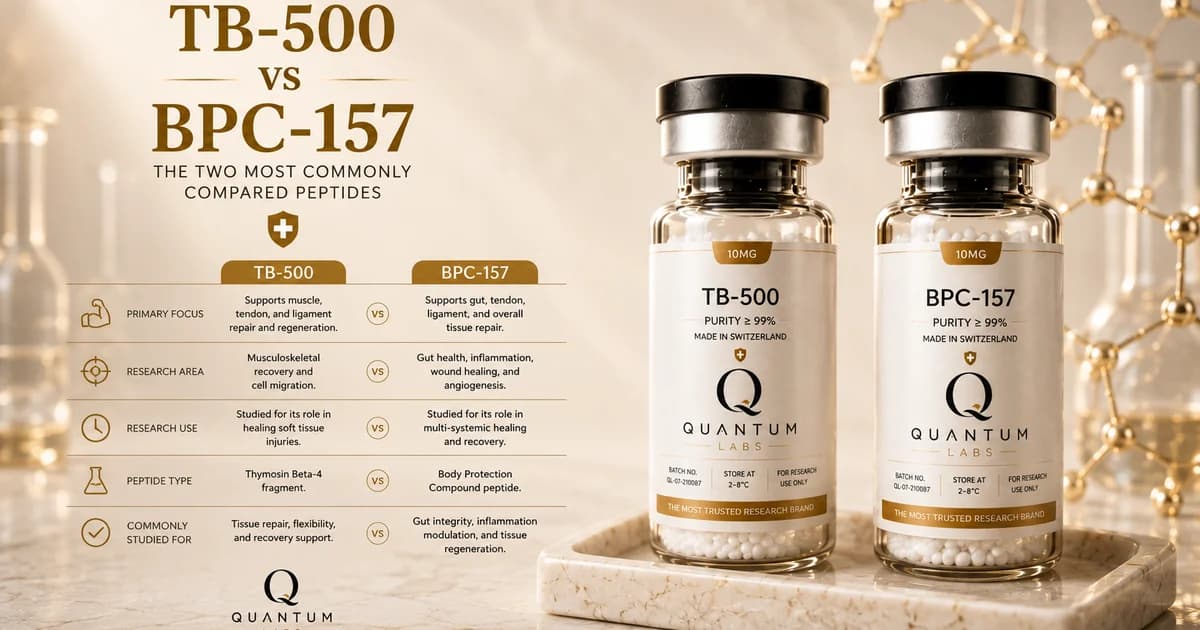
TB-500 and GHK-Cu are both tissue-repair-focused with strong pre-clinical safety data. TB-500 studies have used wide dose ranges in rodent systemic models without significant toxicity signals; GHK-Cu has additional decades of cosmetic-formulation history because the compound has appeared in topical skincare products. Topical cosmetic use is a different safety question to injected research use, but the cosmetic record adds to the broader safety dataset for this compound.
As with BPC-157, the limit of Tier 1 data is that it doesn't directly answer long-term human safety questions. The compounds have favourable pre-clinical tolerability profiles; long-term human safety is not established.
Nootropic peptides: Semax and Selank
Semax and Selank have something most research peptides don't: decades of Russian clinical research. Both compounds were developed at the Russian Academy of Sciences and have been the subject of clinical investigation in Russian healthcare contexts for many years. The published safety record from this corpus is generally favourable, with no major toxicity signals across the studied populations.
The caveat: the Russian clinical literature is not equivalent to a Western regulatory-trial dataset. The studies vary in methodology and population. The body of literature is useful context, but it shouldn't be treated as a substitute for rigorous Western Tier 2/3 data — which doesn't exist for these compounds outside the Russian context.
What every research peptide shares: the unknown unknowns
A common pattern across research peptide safety literature is the gap between what's well-characterised (short-term pre-clinical effects at defined doses) and what isn't (long-term human effects, chronic-exposure effects, drug interactions, effects in special populations). The pre-clinical studies that constitute most of the safety record are designed for specific research questions — they aren't designed to detect every possible long-term human safety signal.
This is one of the reasons research-grade supply is carefully distinguished from therapeutic supply. Researchers working with these compounds in well-designed pre-clinical studies can characterise their compounds further; people using them for therapeutic effect are operating outside the frame the safety data supports.
Purity, contamination, and supply-side safety
A different category of safety risk is supply-side: contamination, mis-identification, or substantially sub-spec purity. Synthetic peptides produced by solid-phase synthesis routinely have deletion-peptide byproducts that aren't the labelled compound. A vial labelled BPC-157 could contain 95% BPC-157 and 5% deletion fragments with unknown pharmacology — and the resulting research data is confounded.
Supply-side safety is what HPLC purity verification and identity confirmation by mass spectrometry are designed to address. Every Quantum Labs compound is verified to ≥99% HPLC purity with identity confirmation, and batch-traceable certificates of analysis are available on request. This isn't the same as clinical safety — it's the foundational input quality that any safety analysis depends on.
How researchers should think about safety
The practical framework for researchers working with research peptides:
- Reference primary literature for the compound's specific pre-clinical safety record.
- Note where Tier 2 / Tier 3 human safety data exists vs where it's missing.
- Source from a supplier that verifies purity and identity — poor input quality contaminates safety analysis.
- Design research protocols within the frame the safety data supports (typically pre-clinical models, defined populations, and study endpoints aligned with the existing literature).
- For clinical questions — for individuals asking about personal use — refer to a qualified medical practitioner. Research-stage safety data does not translate directly to individual-use guidance.
HPLC-verified peptides from Australian stock. Every Quantum Labs compound ships with batch-traceable purity verification — the foundational input quality any research safety analysis depends on. Browse the catalogue →