
Sermorelin vs CJC-1295 vs Tesamorelin: GHRH Analogues Compared | Quantum Labs
Sermorelin, CJC-1295, and Tesamorelin compared — half-life, mechanism, research applications, Australian regulatory status, and which GHRH analogue suits which research.
Three GHRH analogues, three different research profiles
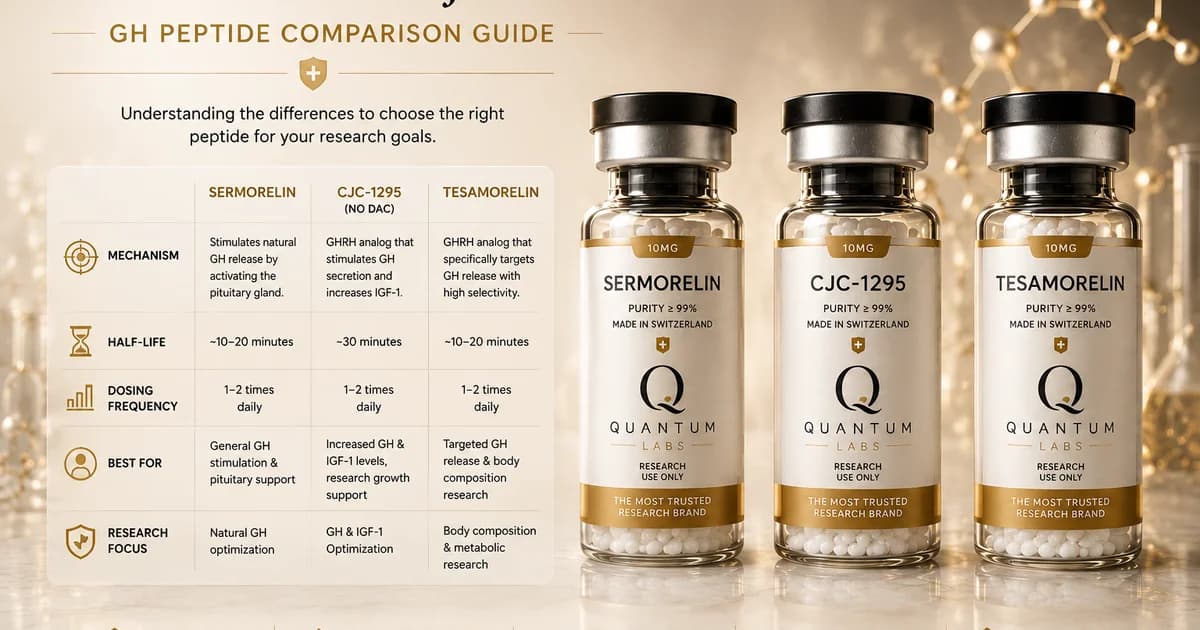
The growth-hormone-releasing-hormone (GHRH) analogue family is one of the most-cited categories in growth-hormone-axis research. Three compounds dominate the published literature: Sermorelin (the original), CJC-1295 (the stabilised long-half-life variant), and Tesamorelin (the only one with regulatory approval in any jurisdiction). All three target the same upstream receptor — the GHRH receptor on pituitary somatotrophs — but their pharmacokinetic profiles differ enough that they answer different research questions.
This article compares the three compounds across mechanism, pharmacokinetics, research applications, regulatory status in Australia, and where each fits in research protocol design. For broader coverage of the wider GH-axis peptide family (including ghrelin agonists like Ipamorelin), see our growth hormone peptides research guide.
The natural compound they're all based on
Native GHRH is a 44-amino-acid peptide released from the hypothalamus that binds the GHRH receptor on pituitary somatotrophs and triggers growth hormone (GH) release. Native GHRH has a very short half-life — minutes — because it's rapidly degraded by dipeptidyl peptidase IV (DPP-IV) in plasma. This short half-life is biologically useful (it allows pulsatile signalling) but practically inconvenient for research because the window of action is too brief for many experimental designs.
The GHRH analogue family modifies the native peptide in different ways to extend the effective duration of action while preserving the receptor activity. The three main modifications:
- Sequence truncation — using only the biologically active N-terminal region (residues 1-29) to create a shorter, easier-to-synthesise compound that retains receptor binding.
- Substitution of DPP-IV-vulnerable residues — replacing the amino acids that DPP-IV recognises so the peptide isn't rapidly degraded.
- Albumin-binding modifications — adding a chemical handle that lets the peptide bind plasma albumin, dramatically extending the half-life from hours to days.
Sermorelin
Sermorelin is the simplest of the three: it's the active 1-29 N-terminal fragment of native GHRH, synthesised as a 29-amino-acid peptide. The name “GRF (1-29)” is sometimes used in older literature.
Key characteristics in research literature:
- Sequence: 29 amino acids, the active fragment of native GHRH.
- Half-life: Short — typically 10-20 minutes in plasma. Mirrors native GHRH closely.
- GH release pattern: Acute pulsatile — single dose produces a GH spike within minutes, returns to baseline within an hour.
- Approval status: Was approved as a therapeutic in the US for paediatric growth hormone deficiency (Geref) — discontinued in 2008 for commercial reasons rather than safety. Not approved in Australia.
Sermorelin is well-studied in pre-clinical and human research for acute GH-release endpoints. Because the half-life is short, research designs using Sermorelin typically dose frequently (often pre-sleep to align with natural overnight GH pulses) and measure acute GH/IGF-1 response rather than sustained effect.
CJC-1295
CJC-1295 is the 1-29 GRF sequence with several modifications to extend half-life and improve stability. It exists in two main research forms:
CJC-1295 without DAC (modified GRF 1-29)
The shorter-acting variant. Half-life on the order of hours rather than minutes — longer than Sermorelin but still short enough to preserve natural pulsatile rhythm. Research designs targeting acute pulsatile GH release typically use this form.
CJC-1295 with DAC
DAC stands for Drug Affinity Complex — a chemical handle that binds plasma albumin and dramatically extends half-life from hours to days (typically 6-8 days). Research using the DAC variant studies sustained GHRH-receptor activation rather than pulsatile signalling.
Key characteristics:
- Sequence: Modified 1-29 GRF with DPP-IV-resistant substitutions; DAC variant adds the albumin-binding modification.
- Half-life: Hours (no-DAC) or days (DAC) — substantially longer than native GHRH or Sermorelin.
- GH release pattern: No-DAC produces a broader pulsatile profile; DAC produces sustained elevation.
- Approval status: Not approved in any jurisdiction. Available for research and laboratory use without therapeutic representation.
- Research pairing: Almost always paired with Ipamorelin in published GH-axis research designs — see the next section.
Research-grade CJC-1295 is supplied paired with Ipamorelin in our CJC-1295 + Ipamorelin product.
Tesamorelin
Tesamorelin is the only GHRH analogue with regulatory approval in any jurisdiction — approved in the US for HIV-associated lipodystrophy under the brand name Egrifta. The compound is a modified version of native GHRH with a hexenoyl group attached at the N-terminus, giving it improved metabolic stability relative to Sermorelin while keeping a different pharmacokinetic profile to CJC-1295.
Key characteristics:
- Sequence: Full-length 44-amino-acid GHRH with an N-terminal hexenoyl modification.
- Half-life: Approximately 26 minutes in plasma — substantially longer than Sermorelin but shorter than CJC-1295 with DAC.
- GH release pattern: Sustained but still roughly within the natural pulse window. Closer to what native GHRH would produce if it lasted longer.
- Approval status: Approved in the US for HIV-associated lipodystrophy. Not approved in Australia. Available for research and laboratory use here without therapeutic representation.
- Notable research: Has the largest body of controlled human clinical trial data of any GHRH analogue because of the US approval pathway.
Research-grade Tesamorelin is available from the Tesamorelin product page.
Side-by-side comparison
Half-life
- Sermorelin: 10-20 minutes (shortest, closest to native GHRH).
- CJC-1295 (no DAC): A few hours.
- Tesamorelin: ~26 minutes.
- CJC-1295 with DAC: 6-8 days (longest).
Research application
- Acute pulsatile GH research: Sermorelin or CJC-1295 without DAC.
- Sustained GH/IGF-1 elevation research: CJC-1295 with DAC, or Tesamorelin for shorter sustained windows.
- Adipose-tissue and lipid-metabolism research: Tesamorelin (largest body of human clinical data in this area thanks to the lipodystrophy approval pathway).
- Ageing-axis / somatopause research: Any of the three, often paired with ghrelin agonists like Ipamorelin.
Australian regulatory status
All three compounds are restricted for compounded human therapeutic supply in Australia and remain available for research and laboratory use when supplied without therapeutic representation. None is on the Australian Register of Therapeutic Goods. None has approved prescription pathways here.
Why CJC-1295 + Ipamorelin pairing dominates research
Almost every contemporary GHRH research design pairs the GHRH analogue with a ghrelin-receptor agonist — most commonly Ipamorelin. The reason is mechanism complementarity:
- GHRH analogues bind the GHRH receptor — one of two independent upstream signals to pituitary somatotrophs.
- Ghrelin agonists bind GHSR-1a — the other upstream signal.
- Combined activation produces a synergistic GH-release response larger than either compound alone, while preserving the natural pulsatile rhythm.
This pairing logic applies to any of the three GHRH analogues discussed here. CJC-1295 + Ipamorelin is the most common combination in research literature, but Sermorelin + Ipamorelin and Tesamorelin + Ipamorelin are also studied. Full coverage of why this pairing works is in our GH peptides research guide.
What about Hexarelin and other secretagogues
Hexarelin is sometimes searched in the same context as Sermorelin and CJC-1295, but it's a different category: Hexarelin is a ghrelin-receptor agonist (like Ipamorelin), not a GHRH analogue. It binds GHSR-1a rather than the GHRH receptor.
Hexarelin produces a strong GH-release response but is generally considered less “selective” than Ipamorelin — earlier ghrelin agonists like Hexarelin tend to produce broader hormonal responses (cortisol, prolactin) that Ipamorelin largely avoids. For most contemporary research designs, Ipamorelin has replaced Hexarelin as the preferred ghrelin-receptor research compound.
Quantum Labs doesn't currently stock Hexarelin. Our ghrelin-pathway research peptide is Ipamorelin, paired with CJC-1295 in the CJC-1295 + Ipamorelin product.
Choosing between them for research
The practical question for Australian researchers: which GHRH analogue suits which research design?
- Acute pulsatile GH response, naturalistic pulse rhythm: Sermorelin or CJC-1295 without DAC. Sermorelin is closer to native GHRH; CJC-1295 (no DAC) gives slightly more practical research-protocol windows.
- Sustained GH/IGF-1 elevation over days: CJC-1295 with DAC. Once-weekly research dosing produces steady-state effects.
- Research design where human clinical data matters: Tesamorelin has the largest body of controlled human trial data.
- Adipose-tissue and lipid-metabolism research: Tesamorelin — substantial human clinical literature in this area.
- Ageing-axis research with comprehensive coverage: CJC-1295 + Ipamorelin + Tesamorelin combined, as in our Hormonal Support Protocol. The combination covers both pulsatile and sustained GHRH-receptor signalling across the cycle.
Regulatory framing reminder
None of these compounds are approved for human therapeutic use in Australia. All three are available for research and laboratory use under the research-supply pathway when supplied without therapeutic representation. Quantum Labs supplies Tesamorelin and CJC-1295 + Ipamorelin as research materials only.
For deeper coverage of the Australian regulatory frame, see our peptide legality guide.
GHRH analogues from Australian stock. Research-grade Tesamorelin and CJC-1295 + Ipamorelin, HPLC-verified to ≥99% purity, batch-traceable. Tesamorelin → · CJC-1295 + Ipamorelin →