
GHK-Cu Copper Peptide: A Research Guide | Quantum Labs
GHK-Cu copper peptide research guide — mechanism, dermal collagen synthesis, hair-follicle research, dosing, side effects, and Australian regulatory context.
What is GHK-Cu?
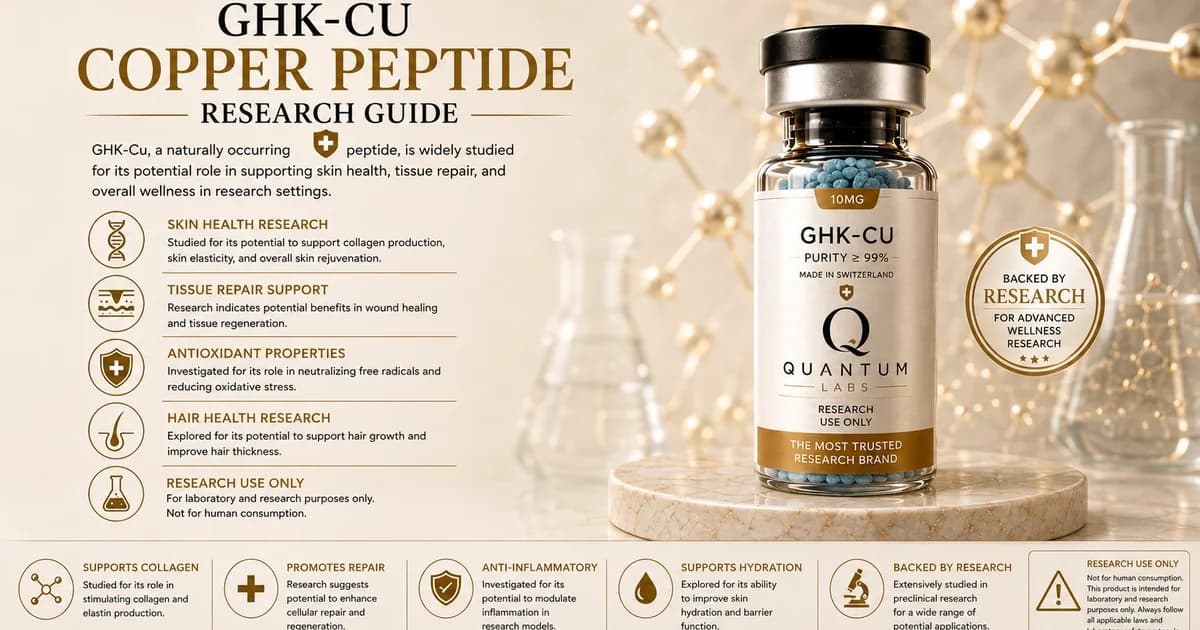
GHK-Cu is a naturally occurring tripeptide-copper complex consisting of three amino acids (Glycyl-L-Histidyl-L-Lysine, or GHK) coordinated with a copper(II) ion. The tripeptide alone has measurable but limited biological activity; the copper-bound form GHK-Cu is the active complex that has been the focus of dermatological, regenerative, and cosmetic research for several decades. For Australian researchers, GHK-Cu is one of the most-studied compounds in the broader peptide-research literature.
The peptide occurs naturally in human plasma at concentrations that decline with age — from about 200 ng/mL in the third decade of life to roughly 80 ng/mL by the seventh. This decline is one of the threads in the longevity-research literature on GHK-Cu, alongside its role in connective tissue, dermal collagen synthesis, and wound-healing research models.
Why the copper matters
The standalone GHK tripeptide and the copper-bound GHK-Cu complex are biologically distinct. GHK without copper has some receptor activity and some chelation capacity, but the copper coordination is what expands the molecule's activity profile substantially. Many of the regenerative and gene-expression effects characterised in published research are specifically dependent on the copper-bound form.
Quantum Labs supplies the pre-formed GHK-Cu complex — the same form that appears in the published research literature. Some research suppliers ship GHK alone and rely on the researcher to add copper separately; we ship the complex ready for reconstitution. This matters because the coordination chemistry of forming the GHK-Cu complex from GHK + copper salts is non-trivial outside laboratory conditions, and ad-hoc preparation introduces inconsistency that confounds research outcomes.
What the research literature documents
GHK-Cu has been the subject of published research for over three decades. The most well-cited research areas:
Dermal collagen synthesis
Research models of dermal fibroblast cultures have consistently shown GHK-Cu modulating collagen synthesis and extracellular matrix protein production. The compound is studied as a putative regulator of dermal remodelling, with implications for skin appearance and wound healing literature.
Hair-follicle research
GHK-Cu has been studied in hair-follicle stem-cell signalling contexts, with pre-clinical and ex-vivo work examining its effects on the hair growth cycle. Cosmetic formulations containing GHK-Cu are common in the hair-care category for this reason, though research-grade work uses the compound differently than topical cosmetic application.
Wound-healing models
Cutaneous and connective-tissue wound-healing models in rodents and ex-vivo human tissue have explored GHK-Cu's effects on the healing cascade. Modulation of TGF-β signalling, integrin expression, and angiogenic pathways are all characterised in this literature.
Gene-expression profiling
A distinguishing feature of GHK-Cu research is the breadth of gene-expression effects characterised in cell-culture work. Studies using transcriptomic profiling have shown GHK-Cu modulating the expression of hundreds of genes involved in tissue repair, immune signalling, and metabolic regulation — a profile that few research peptides match in published literature.
How GHK-Cu is delivered in research
Three primary delivery formats appear in published research:
Topical formulations
The most common research and cosmetic format. GHK-Cu in a suitable carrier penetrates skin in the upper dermal layers. Topical research concentrations span 0.05% to 5% depending on the model. The Ordinary, Niod, and several other cosmetic brands have GHK-Cu serums on the market in Australia at accessible price points — these are listed cosmetic products rather than research material, but they illustrate the topical-delivery format.
Subcutaneous injection
Research models studying systemic GHK-Cu effects often use subcutaneous injection. The reconstituted compound is delivered into the loose subcutaneous tissue, from which it enters circulation. Dose ranges in injected research are variable and protocol-specific.
Intradermal injection
Some dermatological research models use intradermal injection for localised dermal effects. This format is more specialist and less common outside specific research contexts.
GHK-Cu vs other copper peptides
A common point of confusion is the broader “copper peptide” category. GHK-Cu is the most-studied member, but it isn't the only one. Cosmetic formulations sometimes use related copper-coordinated peptides marketed under different names. The research literature on those variants is substantially smaller than the corpus on GHK-Cu specifically.
When research literature refers to “copper peptide” without further specification, it's usually GHK-Cu. When cosmetic marketing refers to copper peptide without specification, it may be GHK-Cu or one of several related coordinated peptides — the specific molecule matters for interpreting any research-claim equivalences. The Ordinary and similar product ranges list their specific peptide composition in their ingredient panels.
The dual regulatory pathway
GHK-Cu has an unusual regulatory position in Australia. Listed cosmetic formulations containing GHK-Cu are widely available on the consumer market — skincare serums, hair-care products, etc. — and these operate under the cosmetic supply pathway. Research-grade GHK-Cu for laboratory study is separately available under the research-supply pathway, governed by different rules. Both pathways are legal; they answer different questions for different customer types.
For Australian researchers, the relevant pathway is research-supply: HPLC-verified compound, batch-traceable certificates of analysis, supplied without therapeutic claims for laboratory and pre-clinical work. The cosmetic product on a pharmacy shelf and the research-grade vial in a lab are different things even when the underlying molecule is the same.
For more on how the regulatory pathways differ across the Australian peptide market, see our peptide legality guide.
Side effects documented in research literature
GHK-Cu has an unusually favourable safety profile in pre-clinical literature. Decades of cosmetic-formulation use add a substantial topical safety record, and pre-clinical rodent injection studies have shown wide tolerability across dose ranges studied. The main documented effects:
- Mild skin irritation in topical applications, particularly at higher concentrations. Usually transient and dose-dependent.
- Injection-site reactions in injected research formats. Standard for any peptide injection; usually mild and transient.
- Copper accumulation theoretical concern — the copper in GHK-Cu is bound in the complex; free copper isn't directly relevant. Studies haven't shown systemic copper-accumulation issues at research doses, but the theoretical question is sometimes raised.
As with all research peptides, long-term human safety data beyond the cosmetic-use record is limited because GHK-Cu hasn't undergone the full regulatory trial process for a specific therapeutic indication. For deeper discussion of research-peptide safety more generally, see our peptide safety overview.
GHK-Cu in research stacks
GHK-Cu appears in research stacks alongside other tissue-repair and regenerative compounds. The combinations exploit complementary mechanisms — GHK-Cu's effects on dermal collagen and connective tissue alongside other peptides' effects on deeper repair pathways.
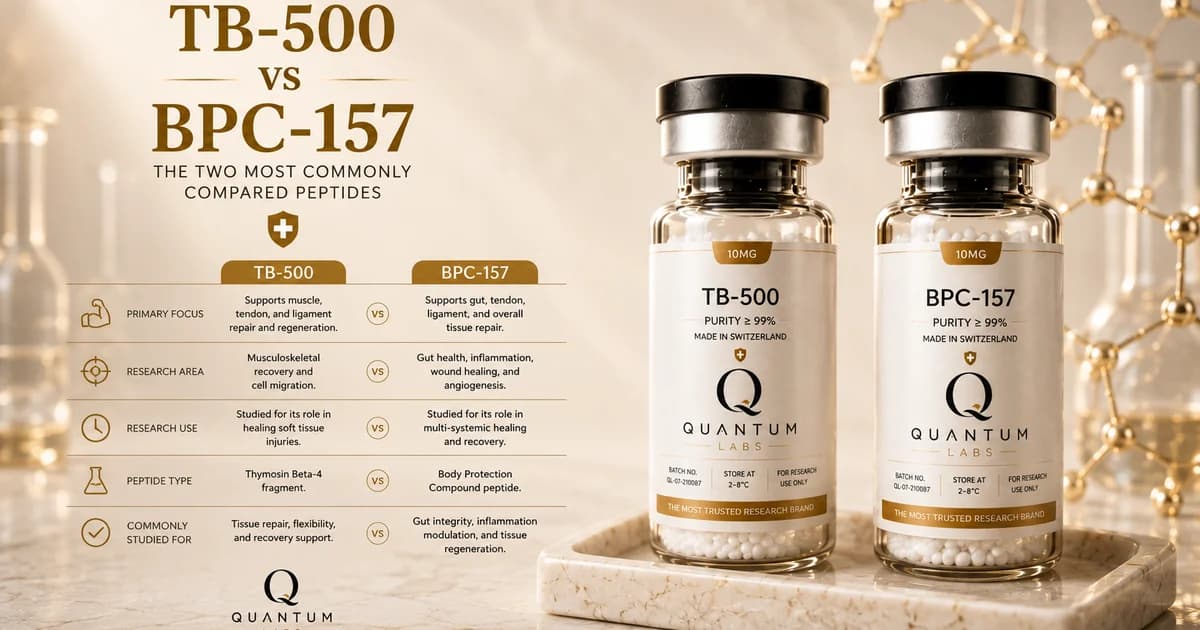
The most common stack pairing in our catalog is GHK-Cu with the BPC-157 + TB-500 combination, which is the foundation of the Quantum Labs Recovery & Repair Stack. The pairing logic:
- BPC-157 covers angiogenic and NO-pathway signalling.
- TB-500 covers actin / cell-migration mechanisms.
- GHK-Cu covers dermal collagen synthesis and superficial connective-tissue remodelling.
The three compounds cover different parts of the tissue-repair cascade — combining them gives broader coverage in a single research protocol than any one compound alone.
Reconstitution specifics for GHK-Cu
The standard research peptide reconstitution process (covered in our reconstitution guide) applies to GHK-Cu with one cosmetic difference: the reconstituted solution is faintly blue, due to the copper coordination. This is normal and expected — not contamination. The colour intensity scales with concentration; higher concentrations produce a more visibly blue solution.
Otherwise the process is standard: bacteriostatic water diluent, gentle swirling (no shaking), 2-8°C storage, 30-day use window. Lyophilised GHK-Cu has good shelf life at refrigerator temperature in unopened sealed vials.
Research dosing in published literature
Topical research formulations have used GHK-Cu concentrations from 0.05% to 5% depending on the research model. The higher end is more common in dermatological research; the lower end matches typical cosmetic-grade serum concentrations that have decades of use history.
Injected research doses vary substantially by study design and species. Pre-clinical rodent work has used wide dose ranges. Human therapeutic dosing isn't established because GHK-Cu hasn't been through the approval process for a specific human indication. Researchers should reference primary literature for protocol-specific dosing guidance.
Why source from Australia
For Australian researchers, sourcing GHK-Cu domestically matters for three reasons. First, shipping: lyophilised peptides ship at room temperature for short periods, but longer transit times degrade stability and add risk of freeze-thaw damage if cold-chain isn't maintained. Second, supply quality: HPLC-verified research-grade material with batch-traceable certificates of analysis is the baseline that any quantitative research analysis depends on. Third, regulatory clarity: domestic research-supply operates under the Australian framework directly, without the import-pathway complexity that international supply introduces.
Quantum Labs supplies GHK-Cu from Australian stock, HPLC-verified to ≥99% purity, shipped lyophilised in sealed vials with batch identifiers traceable to certificates of analysis.
HPLC-verified GHK-Cu from Australian stock. Pre-formed copper-bound complex (not GHK alone), batch certificates of analysis available on request. View GHK-Cu in the catalogue →