
Peptides for Hair Growth: A Research Guide | Quantum Labs
Peptides for hair growth research — GHK-Cu, BPC-157, the hair-cycle biology, cosmetic-vs-research pathways, and dual regulatory framework in Australia.
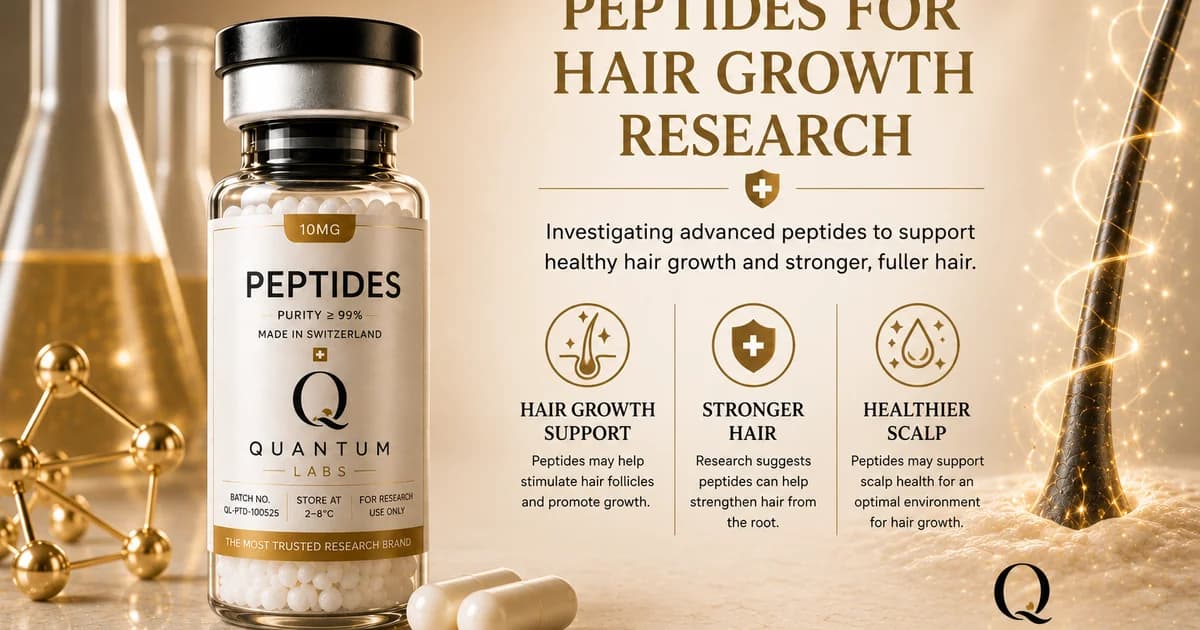
The peptides studied in hair-biology research
Hair-growth research is a substantial sub-field of dermal biology, and several research peptides feature in the published literature. The biology is mechanically intricate — hair follicles cycle through distinct phases (anagen growth, catagen transition, telogen rest), with stem-cell niches in the follicle bulge driving the cycle. Peptides studied in hair-growth contexts target one or more of these phases through different mechanisms.
For Australian researchers and consumers searching “peptides for hair growth”, the answer splits two ways: cosmetic peptide-containing hair products (The Ordinary's multi-peptide hair serum being the most-cited example in AU search data) sit in the cosmetic supply pathway; research-grade peptides for laboratory hair-biology work sit in the research supply pathway. This article covers both perspectives with the research side as the primary focus.
The hair cycle: where peptides fit
Hair growth happens in three phases that repeat throughout life:
- Anagen — active growth phase. The hair follicle is metabolically active, the hair shaft is being produced, and the follicle is at its longest. Scalp hair anagen typically lasts 2-6 years. The anagen-phase duration is the main determinant of hair length.
- Catagen — transition phase. A short (2-3 week) regression phase where the follicle stops producing hair and shortens significantly.
- Telogen — resting phase. The follicle is inactive for 2-4 months, then the hair sheds and the cycle restarts with a new anagen phase.
Hair loss conditions involve either premature termination of anagen, prolonged telogen, follicle miniaturisation, or follicle destruction. Research peptides studied for hair biology target specific mechanisms within this cycle — extending anagen, supporting the dermal papilla (the mesenchymal structure that regulates the hair cycle), modulating signalling at the follicle stem-cell niche, or supporting the cellular environment that allows the cycle to continue.
GHK-Cu: the most-cited hair-research peptide
GHK-Cu has the deepest published research record in hair biology among the peptides in our catalog. The compound has been studied for:
- Hair-follicle stem-cell signalling at the bulge niche.
- Dermal papilla cell function and proliferation.
- Modulation of TGF-β signalling, which influences anagen duration in research models.
- Hair cycle phase transitions in ex-vivo and animal studies.
The mechanisms are consistent across the published research, and GHK-Cu features in many of the topical peptide formulations marketed for hair density and growth. The cosmetic-formulation side is well-established in Australia — GHK-Cu serums and hair tonics are widely available — and rests on decades of research and use history.
For research-grade GHK-Cu for laboratory hair-biology work, see the GHK-Cu product page. For broader coverage of GHK-Cu mechanisms across research areas, see our copper peptide research guide.
The multi-peptide hair serum cluster
One of the most-searched AU queries in the hair-peptide space is “The Ordinary multi-peptide serum for hair density.” This is a specific cosmetic product — a topical serum containing multiple peptides aimed at consumer hair-density outcomes. It's a useful market touchstone for what cosmetic-pathway hair peptides look like:
- Multiple peptides combined in a single formulation rather than a single research-grade compound.
- Topical delivery via direct scalp application.
- Cosmetic-formulation regulatory pathway, not therapeutic supply.
- Consumer outcomes (density, fullness, appearance) as the measured endpoint rather than research-grade biological mechanisms.
The cosmetic supply pathway is the appropriate channel for consumers looking at peptide-containing hair products. Research-grade supply is for laboratory hair-biology investigation, not for consumer hair-care use.
BPC-157 and angiogenic-pathway hair research
BPC-157's primary research literature is in tendon and tissue repair, but some published work has examined the compound in cutaneous and follicle contexts. The relevance to hair biology rests on BPC-157's effects on VEGF-driven angiogenesis — new blood vessel formation that supports tissue including hair follicles. The hair follicle bulb is metabolically demanding during anagen and requires substantial vascular supply; impaired vascular support contributes to age-related follicle miniaturisation in some research models.
BPC-157 isn't the headline hair-research peptide that GHK-Cu is, but its angiogenic mechanism is conceptually relevant. Research-grade BPC-157 is available from the BPC-157 product page.
What the published literature actually documents
The honest read of the hair-peptide research literature:
- Mechanism research is strong. The cellular and molecular pathways through which peptides affect hair-follicle biology are well-characterised. GHK-Cu has decades of research; the supporting compounds have their own bodies of work.
- Animal-model outcomes are mixed. Different research designs produce different magnitudes of effect. The compounds work — but the effect size and the translation from in-vitro to in-vivo varies.
- Human consumer outcomes are difficult to isolate. Cosmetic hair products are nearly always multi-ingredient formulations, which makes attribution to specific peptides difficult in consumer-outcome studies.
- Established hair-loss treatments differ. Minoxidil and finasteride remain the most evidence-supported hair-loss interventions in the medical literature. Peptide research is supplementary rather than replacement to those established compounds.
For consumers asking about peptides for personal hair-loss treatment, a dermatologist who understands both the evidence-based interventions and the cosmetic-formulation landscape is the right referee. For researchers studying hair-biology mechanisms, research-grade peptide supply enables specific laboratory work.
Delivery formats for hair-research peptides
Three delivery formats appear in the published hair-research literature:
Topical scalp application
The most common format for both cosmetic products and some research applications. Peptides in a suitable carrier formulation are applied directly to the scalp and absorb through the follicular openings. Penetration is the major variable — formulation quality determines whether the peptide reaches the active region of the follicle.
Subcutaneous injection
Research models studying systemic peptide effects on hair biology use subcutaneous administration. The peptide enters circulation and affects follicles at a systemic level. This is the standard research-grade format for compounds like BPC-157, GHK-Cu, and others in laboratory study.
Mesotherapy / intradermal injection
Some specialist medical contexts use intradermal injection directly into the scalp dermis. This is a clinical procedure done by qualified practitioners and is separate from research-supply or cosmetic-supply use.
The dual regulatory landscape for hair peptides
As with skin peptides, hair-related peptide products sit on two regulatory pathways simultaneously:
- Cosmetic supply. Listed cosmetic products (serums, tonics, leave-on treatments) containing peptides for consumer use. Marketed for appearance and density claims under cosmetic-regulation rules.
- Research supply. Research-grade peptides for laboratory and pre-clinical study of hair-biology mechanisms. Supplied without therapeutic representation, for research use only.
The same compound can sit in both pathways — GHK-Cu being the obvious example. The regulatory category depends on the supply context, packaging, and claims rather than the molecule alone. For broader regulatory context, see our peptide legality guide.
What Quantum Labs supplies for hair-biology research
For Australian researchers working on hair-biology questions, our catalog covers:
- GHK-Cu — the most-cited research peptide in hair-follicle biology literature. Pre-formed copper-bound complex, HPLC-verified to ≥99% purity.
- BPC-157 — angiogenic-pathway research relevant to follicle vascular support biology.
- TB-500 — actin and cell-migration research relevant to follicle-cycle stem cell dynamics.
We don't supply consumer-grade peptide hair serums — The Ordinary, Niod, and the specialist cosmetic brands are the appropriate channels for those. Our compounds are research-grade material for laboratory work.
Research considerations specific to hair work
A few specific notes for hair-biology research:
- Timeline. Hair-cycle research operates on longer timeframes than tissue-repair or metabolic-pathway work. Anagen-extension studies run for months to years. The 6-12 week research-peptide cycles common elsewhere don't map onto hair-cycle biology directly.
- Endpoint measurement. Quantifying hair outcomes in research requires standardised photo-trichograms, follicle counts, or histological sampling. Pre-specified endpoints prevent the interpretation-bias issues common in cosmetic-formulation literature.
- Multi-mechanism stacks. Hair biology involves multiple pathways simultaneously, which is why cosmetic formulations almost always combine multiple peptides. Research designs studying the underlying mechanisms work the other direction — isolating one peptide at a time to characterise its specific effect.
The honest position on peptides for hair
Hair-loss research is a competitive and contested field. The most evidence-supported interventions remain minoxidil, finasteride, low-level laser therapy, and (in specific contexts) surgical transplantation. Peptide research is an active and growing supplementary area, with mechanisms that plausibly target relevant follicle biology — but the translation from mechanism research to consumer outcome is where the field is still working through the evidence base.
Quantum Labs supplies research-grade peptides for laboratory hair-biology research. We don't make consumer claims about hair growth or hair-loss reversal. For personal hair-loss questions, a dermatologist who understands the full evidence landscape is the right referee.
Research-grade peptides for hair-biology research. GHK-Cu and supporting compounds available from Australian stock, HPLC-verified. View GHK-Cu →