

TB-500 Australia: Thymosin β-4 Fragment Research Guide | Quantum Labs
Standalone TB-500 research guide — actin-binding mechanism, tissue-repair models, handling, Australian supply framing, and how it differs from BPC-157.
What is TB-500?
TB-500 is a synthetic peptide fragment corresponding to the active actin-binding region of thymosin β-4 (Tβ4), a 43-amino-acid protein present in virtually all mammalian cells. The short synthetic sequence most suppliers label “TB-500” centres on the LKKTETQ motif — the domain most strongly associated with actin sequestration and cell-migration research endpoints.
Full-length thymosin β-4 and the short TB-500 fragment are related but not identical research tools. The fragment is easier to synthesise at research purity, dominates pre-clinical tissue-repair discussions, and is the form Quantum Labs supplies as lyophilised TB-500 for Australian laboratory use.
Why researchers study TB-500
TB-500 appears in soft-tissue, wound-healing, and regenerative research because actin dynamics sit at the centre of cell motility and cytoskeletal reorganisation. When cells migrate into a repair field, polymerise actin, or remodel extracellular matrix neighbourhoods, pathways that touch G-actin regulation become natural experimental targets.
Pre-clinical literature and secondary research summaries commonly discuss TB-500 in models of:
- Soft-tissue and tendon injury paradigms
- Wound closure and dermal repair models
- Endothelial cell migration / angiogenesis interest
- Systemic distribution after parenteral administration
That list is a map of research attention — not a set of human treatment claims. TB-500 is not an approved Australian medicine for injury recovery. Quantum Labs supplies it for research use only.
Mechanism: actin first, narratives second
The cleanest mechanistic story for TB-500 starts with actin binding. Thymosin β-4 sequesters monomeric G-actin; the TB-500 fragment retains the core binding motif used in that interaction. Downstream narratives in secondary literature (inflammation resolution, fibrosis modulation, stem-cell niche effects) should be treated as hypotheses under study unless a primary paper for your exact model supports them.
A practical research implication: TB-500 is often described as more “systemic” in distribution discussions than highly local growth-factor injections. Study designs that assume purely local action without measuring systemic markers may misread endpoints. Build assays accordingly.
TB-500 vs BPC-157 (complementary, not duplicate)
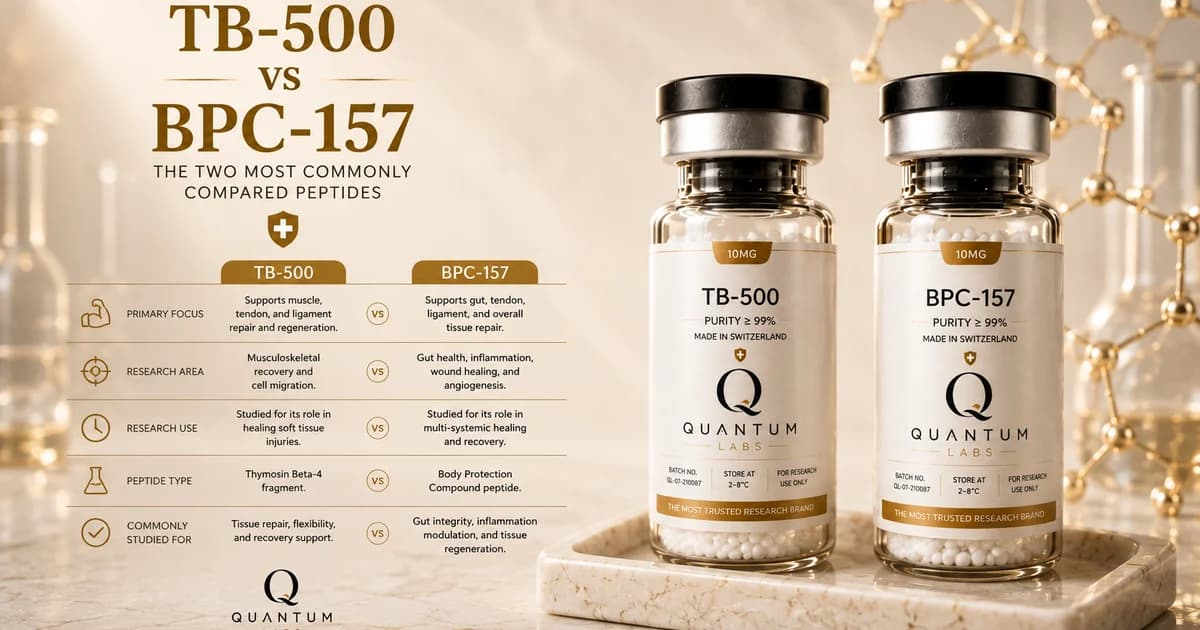
Almost every recovery-stack conversation pairs TB-500 with BPC-157. The pairing is popular because the proposed pathways differ: BPC-157 research emphasises nitric oxide signalling, VEGF-related angiogenesis themes, and gastrointestinal as well as musculoskeletal models; TB-500 research emphasises actin and cell migration. Overlap exists at the level of “tissue repair models,” not at the level of identical molecular targets.
For a head-to-head comparison, see TB-500 vs BPC-157. For a pre-portioned dual supply, see the BPC-157 + TB-500 research stack. For broader recovery context: peptides for injury recovery research.
Research dosing ranges in the literature
Animal studies have used TB-500 / thymosin-β4-fragment doses across a wide mg/kg band (commonly discussed experimental ranges fall roughly in the low single-digit to low double-digit mg/kg territory depending on model and route). Those numbers are not human therapeutic prescriptions. They are experimental anchors. Protocol authors should cite primary papers for species, route, vehicle, and schedule rather than copy forum conversions.
Handling, reconstitution, and storage
TB-500 is typically supplied lyophilised. Standard research handling:
- Reconstitute with bacteriostatic water (or study-specified sterile vehicle)
- Refrigerate working solutions; avoid repeated freeze–thaw
- Keep unopened lyophilised vials cool, dry, and batch-labelled
- Record reconstitution date and concentration for the lab book
Use the reconstitution calculator for volume maths and the storage stability tool for post-reconstitution dating guidance. Bacteriostatic water is available as a separate research supply.
Australian legal and supply framing
TB-500 has faced compounding and advertising restrictions in Australia when presented as a human therapeutic. Research-grade supply without therapeutic claims is a different channel — still requiring honest labelling, age gates, and no disease or bodybuilding cure marketing. Quantum Labs ships TB-500 from Australian stock for research use only.
Context reading: peptide legality in Australia, research peptides Australia guide, and quality / HPLC / COA standards.
How to evaluate TB-500 material quality
Tissue-repair models punish impure peptides. Demand at minimum:
- Stated HPLC purity floor (≥99% for our catalogue)
- Identity confirmation (mass spectrometry)
- Third-party certificates, not only marketing PDFs
- Traceable batch codes on the vial
Supplier evaluation frameworks we use editorially are the same ones described in how to source quality research peptides in Australia.
Related Quantum Labs destinations
TB-500 for Australian research supply. HPLC-verified ≥99% purity, third-party tested, dispatched from Australian stock. View TB-500 · Compare with BPC-157 · Quality & COAs.