
Peptides for Injury Recovery: A Research Guide | Quantum Labs
Peptides for injury recovery research — BPC-157, TB-500, GHK-Cu, Glutathione, GH secretagogues. Mechanisms, cascade stages, and stack design for AU research.
The research-peptide landscape for recovery
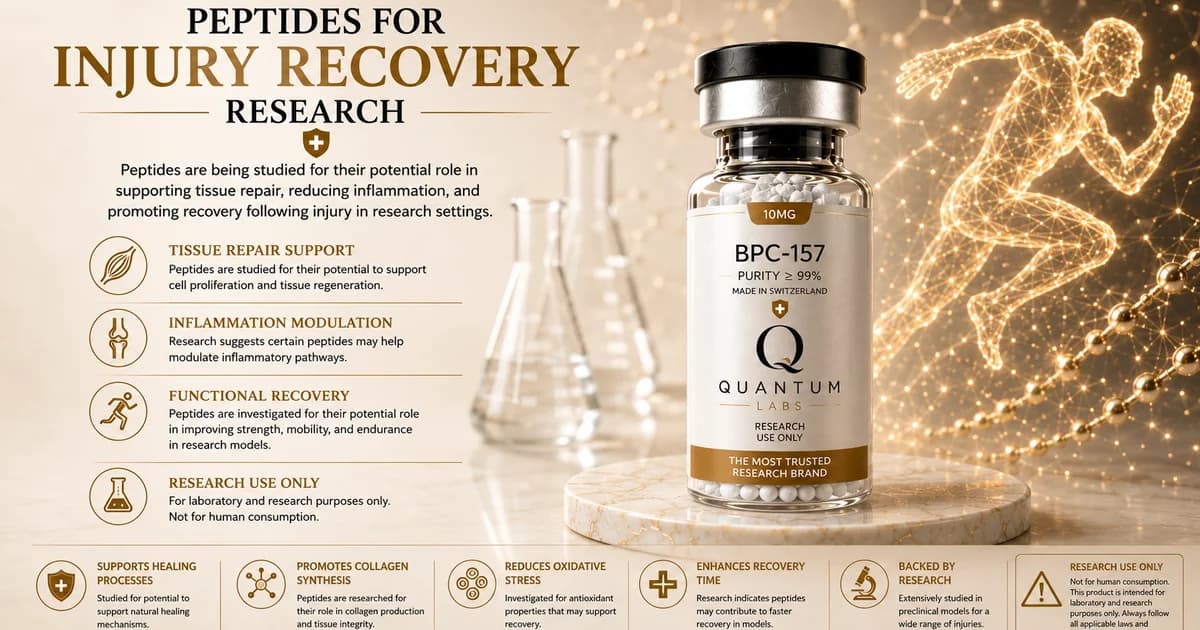
Injury recovery research is one of the largest threads in the broader research-peptide literature. The reason is practical: the underlying biology of tissue repair — inflammation, vascular response, cell migration, proliferation, collagen synthesis, remodelling — is rich enough that multiple peptide compounds can target different parts of the cascade. Researchers studying peptides for injury recovery are working with one of the best-characterised problems in the field.
This article walks through the compounds that appear most often in injury-recovery research literature, what aspect of the repair cascade each one targets, and how they combine in published study designs. The framing is research — pre-clinical animal models, ex-vivo tissue work, mechanism studies. Clinical questions for individuals recovering from real injuries should be directed to a qualified medical practitioner.
The tissue-repair cascade in five stages
Most published research peptides target specific stages of the broader repair cascade. Understanding the stages makes the compound choices below make sense:
- Vascular response. Damaged tissue first triggers a vascular response — vasoconstriction then vasodilation, with platelet aggregation and clotting cascade activation. Adequate blood supply to the injury site is foundational for everything downstream.
- Inflammation. Immune cells migrate to the injury site, clear debris and pathogens, and release cytokines that orchestrate the next stages. Inflammation is essential for repair but excessive or prolonged inflammation impairs the cascade.
- Cell migration and proliferation. Fibroblasts, endothelial cells, and other repair cells migrate to the wound and proliferate. This stage involves substantial cytoskeletal remodelling.
- Collagen synthesis and matrix deposition. Fibroblasts produce new collagen and extracellular matrix, forming the structural scaffold of the repaired tissue.
- Remodelling. The initial repair tissue is remodelled over weeks to months — collagen organisation improves, the matrix matures, and tissue mechanical properties approach (but rarely fully match) the original tissue.
Different research peptides act on different stages. A well-designed research stack covers more of the cascade than any single compound.
BPC-157: angiogenesis + tendon focus
BPC-157 is the most-cited research peptide in tissue-repair literature, particularly in tendon and ligament research. Its mechanisms span the vascular and collagen-synthesis sides of the cascade:
- Modulates the nitric oxide system in damaged tissue.
- Promotes VEGF-driven angiogenesis at injury sites — new blood vessel formation that supports the rest of the repair process.
- Upregulates growth hormone receptor expression in tendon fibroblasts, amplifying the local response to growth-hormone signalling during repair.
- Has demonstrated effects in tendon-to-bone healing models, muscle crush injury models, and ligament-repair models.
Full coverage of BPC-157 mechanism and the research literature is in our BPC-157 research summary. Source from the BPC-157 product page.
TB-500: cell migration + cytoskeletal remodelling
TB-500 is the synthetic fragment of thymosin β-4 containing the actin-binding domain. Where BPC-157 covers the vascular and growth-factor sides, TB-500 covers the cell-migration and cytoskeletal-remodelling sides:
- Sequesters G-actin in the cytoplasm, modulating actin polymerisation dynamics.
- Accelerates endothelial cell migration — related to angiogenesis but mechanistically distinct from BPC-157's VEGF-driven pathway.
- Modulates inflammatory cell behaviour during the early repair stages.
- Influences progenitor cell differentiation toward repair phenotypes.
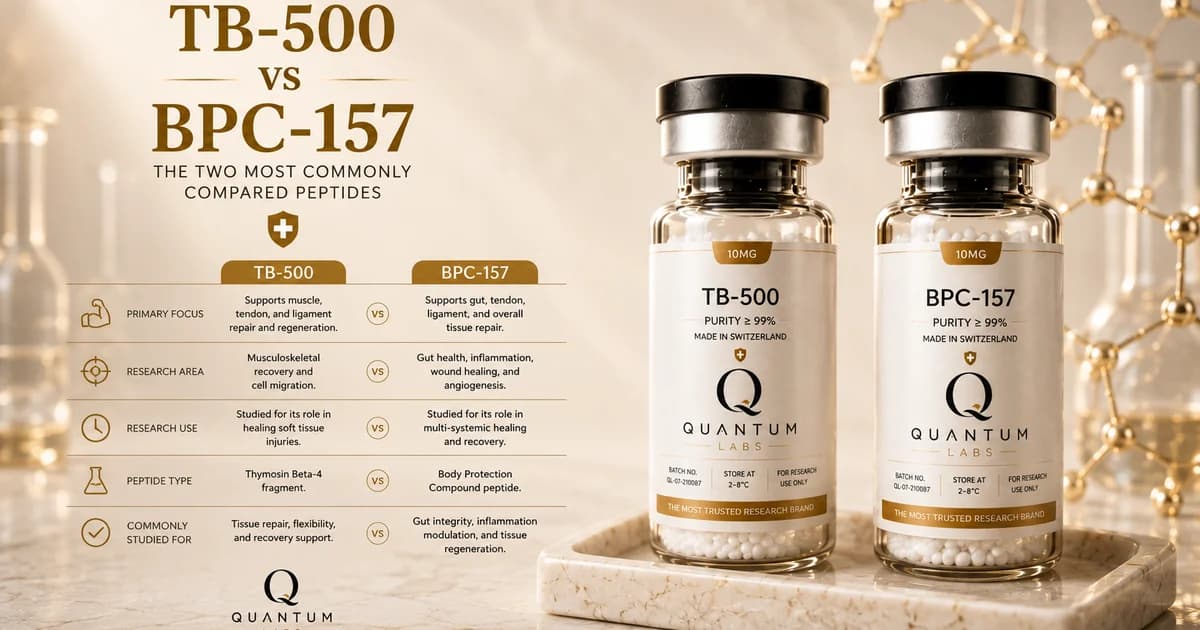
The complementarity between TB-500 and BPC-157 is why they appear together so often in published recovery research. Detailed comparison in our TB-500 vs BPC-157 article. Source from the TB-500 product page.
GHK-Cu: collagen synthesis + dermal pathways
GHK-Cu is the copper-peptide complex that has been the subject of decades of dermatological and regenerative research. In an injury-recovery context:
- Stimulates collagen synthesis in dermal fibroblast cultures.
- Modulates TGF-β signalling and integrin expression during wound healing.
- Influences extracellular matrix protein production — relevant to both dermal and deeper connective tissue repair.
- Has dual research and cosmetic-supply pathways, so the broader safety record is more accessible than for purely research-supply peptides.
Full GHK-Cu coverage in our copper peptide research guide. Source from the GHK-Cu product page.
Growth-hormone secretagogues: systemic anabolic signalling
For research designs investigating recovery from high-volume training or chronic-load injuries, GH secretagogues can play a supporting role. Growth hormone modulates protein synthesis, collagen turnover, and recovery-cycle physiology broadly. The most common compounds:
- CJC-1295 — GHRH analogue, supports pulsatile GH release.
- Ipamorelin — selective ghrelin agonist, also drives GH release through an independent pathway.
- Tesamorelin — stabilised GHRH analogue with a different half-life profile to CJC-1295.
GH secretagogues are studied as supporting compounds in recovery research — they don't directly target tissue repair the way BPC-157, TB-500, and GHK-Cu do, but they modulate the broader anabolic and collagen-synthesis environment in which repair occurs. Coverage of this family in our growth hormone peptides guide.
Glutathione: antioxidant support during recovery
Recovery research often pairs the headline peptides with foundational support compounds. The most common is Glutathione, the tripeptide that serves as the most abundant intracellular antioxidant in mammalian cells.
High-load training and tissue-repair states involve elevated oxidative stress. Glutathione supports the cellular redox environment during these states. It isn't a direct repair-pathway compound in the same way as BPC-157 — it supports the cellular conditions under which repair pathways function. Research stacks targeting recovery commonly include it as supporting biology.
The Quantum Labs Recovery & Repair Stack
Our Recovery & Repair Stack assembles four of the most-studied recovery-research compounds into a single 8-week research kit:
- 2× BPC-157 + TB-500 combination vials — the two most-cited tissue-repair compounds, in pre-portioned combination format for paired-administration research designs.
- 1× GHK-Cu vial — for the dermal collagen synthesis and connective tissue side.
- 2× Glutathione vials — for the supporting antioxidant biology during the research cycle.
The stack covers vascular response (BPC-157), cell migration (TB-500), collagen synthesis (GHK-Cu), and the cellular redox environment (Glutathione) across the 8-week cycle structure common in tendon and connective-tissue research protocols.
What injury type does each compound suit?
A frequent question in the research literature is which compound family suits which injury model. A rough mapping from published study designs:
- Tendon-to-bone attachment (rotator cuff models, Achilles, patellar): BPC-157 has the deepest research record here.
- Soft-tissue muscle injuries (crush models, strains): both BPC-157 and TB-500 have published work.
- Ligament repair (ACL, MCL models): BPC-157 with TB-500 commonly paired for combined angiogenic + actin-pathway research.
- Dermal wound healing (cutaneous wound models): GHK-Cu has the broadest published record in this specific tissue.
- Connective-tissue rehabilitation (chronic-load research): the full Recovery & Repair Stack combination addresses the broader cascade across compounds.
The honest caveat: pre-clinical research models don't map perfectly onto human clinical injury types. Researchers studying these compounds in published literature work in well-defined model systems; clinical translation involves additional considerations that medical practitioners handle for individual patients.
Research cycle structure for recovery work
Tissue-repair research cycles in published literature typically run:
- Acute injury models: 4-6 weeks of intervention, with measurements at baseline, mid-cycle, and post-intervention.
- Chronic-load or rehabilitation models: 8-12 weeks, with extended measurement windows that capture both repair and early remodelling.
The Quantum Labs Recovery & Repair Stack is sized for the 8-week middle ground — long enough to capture meaningful repair-cascade activity, short enough to fit standard research protocol windows. For more on how cycle structure works in research peptide protocols, see our peptide cycling 101 guide.
Where this fits in the broader regulatory frame
BPC-157, TB-500, and GHK-Cu are all restricted for human therapeutic supply under the TGA's compounding framework in Australia, but remain available for research and laboratory use when supplied without therapeutic representation. Glutathione is available for research and supplementary use. The Recovery & Repair Stack is supplied for laboratory research use only.
For more on the Australian regulatory frame for research peptides, see our peptide legality guide. For safety considerations across the family, see our peptide safety overview.
The Quantum Labs Recovery & Repair Stack. Four research compounds for tissue-repair research, sized for the 8-week cycle, HPLC-verified to ≥99% purity, shipped together from Australian stock. View the Recovery & Repair Stack →